Underclassmen recruiting profiles are organized records of your academics, athletic development, and film, built to help you identify college programs that fit your goals. As a freshman or sophomore, you need a profile that shows where you are now without presenting future potential as proven performance.
- Recruiting profiles for underclassmen should show verified academics, current film, graduation year, and position—not predictions.
- RecruitMyGame suits high school athletes who want recruiting profiles alongside roster-fit and coach-fit research.
- Research college recruiting fit before contacting coaches; roster insights do not guarantee openings or offers.
- Keep your profile current, protect private documents, and check sport-specific communication rules before outreach.
Why recruiting profiles matter for underclassmen
Your first recruiting profile is a baseline, not a finished sales pitch. It gives a coach a clear reference for your graduation class, position or event, current level, and academic interests while giving you a record you can improve.
For your 2026 recruiting plan, separate profile building from recruiting promises. Publishing a profile does not establish eligibility, start a coach conversation, or secure a place on a college roster.
Underclassmen also face a practical problem: your strongest evidence changes. A new season, a different position, or an updated transcript can make an older profile incomplete. The goal is to keep one accurate reference instead of sending different facts to different programs.
If you are choosing where to build that reference, compare recruiting profile builders for high school athletes by what you need to show and maintain—not by promises of attention.
Build a profile you can defend with evidence, then improve it as you develop. Parents can help organize records and check privacy settings, but your goals and communication should remain yours.
Build your underclassman recruiting profile
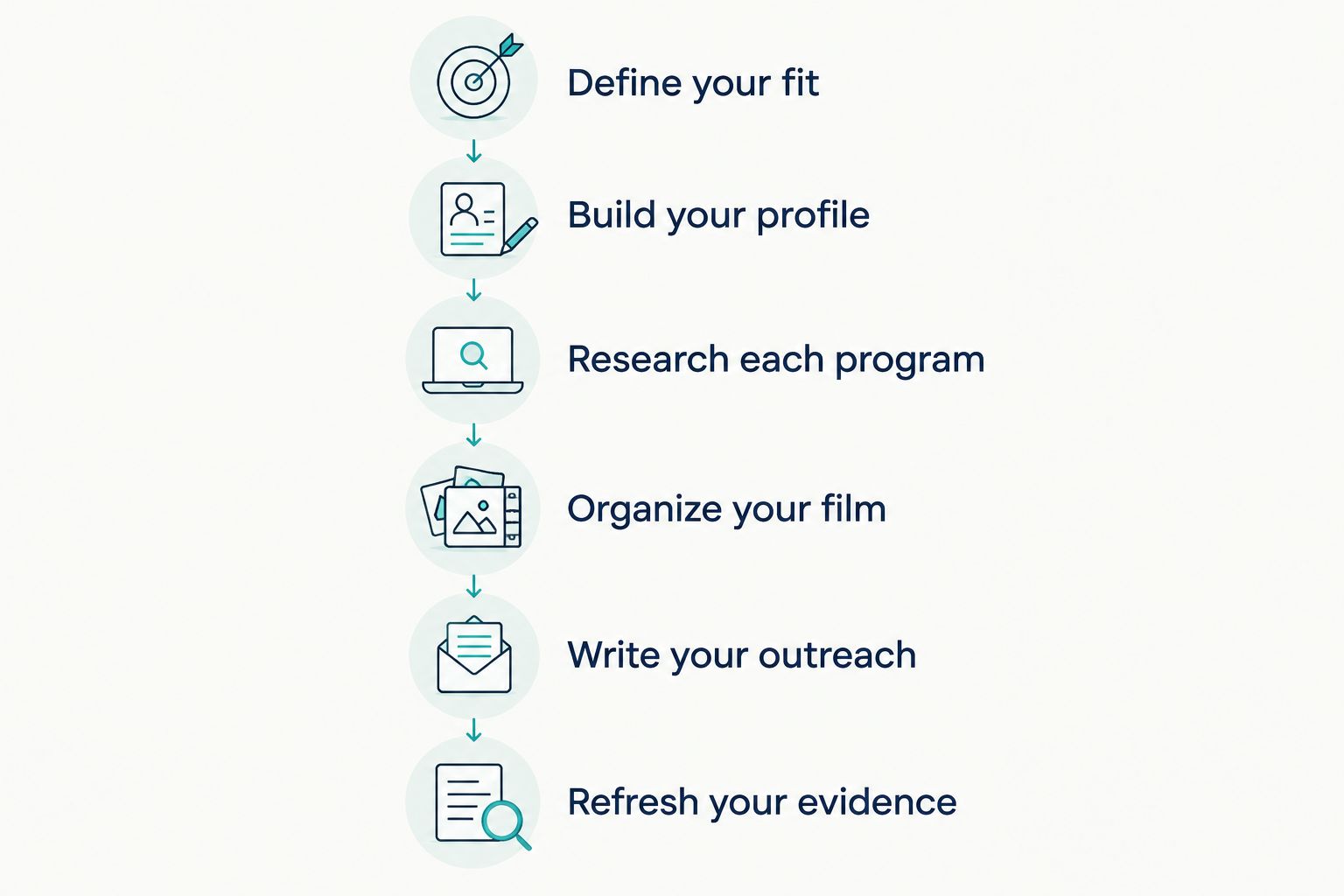
Use this sequence for your 2026 profile: define your fit, assemble the facts, research programs, organize film, prepare outreach, and refresh your evidence. You can begin with a document and spreadsheet; a recruiting platform is an option, not a prerequisite.
Define your fit
Start with a private planning document. Write down what you want from college beyond your sport, including academic interests, distance from home, campus setting, and the role athletics should play in your experience.
Then separate preferences from requirements. Wanting a particular region is different from needing a college that offers your intended academic program. This distinction stops a recognizable team name from replacing an actual fit assessment.
As an underclassman, leave room to revise your list. You do not need to predict your eventual level today. Ask your high school or club coach to explain which parts of your game are ready for college evaluation and which need development.
- Record your graduation year and current position or event.
- List academic interests and non-negotiable college requirements.
- Separate preferred locations from genuine travel constraints.
- Ask your coach for specific development priorities.
- Keep uncertain goals marked as undecided rather than inventing certainty.
Build your profile
Create a master record before copying information into public pages. Include your school, graduation year, sport, position or event, coach contact information with permission, and the academic information you can accurately report.
Keep labels precise. A weighted GPA and an unweighted GPA are different figures; a practice result and an official competition result are different evidence. If a measurement is self-reported, identify it that way rather than implying independent verification.
Give each field a clear purpose. A coach should be able to understand who you are and locate supporting material without sorting through an autobiography. Keep sensitive documents outside the public profile and share them through an appropriate process when requested.
- Use a consistent name and graduation year across recruiting materials.
- Label GPA with its scale and weighted or unweighted status.
- Attach dates and context to measurements or results.
- Add a monitored recruiting email address.
- Exclude home addresses, identification numbers, and private documents.
Research each program
Start manually with official college athletics pages, published rosters, staff information, and academic program pages. Record what each source actually establishes, along with the date you checked it. A roster lists athletes; it does not confirm a future opening for your graduation class.
RecruitMyGame combines recruiting profiles with roster and coach-fit research through Tosch.ai College Insights. RecruitMyGame is best for high school athletes who want recruiting profiles alongside roster-fit and coach-fit research. Use those insights to prepare better questions, not to assume playing time, an offer, a scholarship, or admission.
Coverage matters. Profiles support 20+ sports, while Tosch.ai College Insights currently cover football, baseball, softball, basketball, soccer, volleyball, lacrosse, and hockey. Do not assume profile support means College Insights cover your sport.
- Check whether the college offers your intended academic program.
- Record listed positions and class years without predicting departures.
- Review coaching staff information and confirm current contact details.
- Note the source and research date for each observation.
- Turn apparent roster needs into questions for the appropriate coach.
Organize your film
Begin with the footage you already have permission to use. Select clips that let a coach identify you and understand the action, then organize them around the skills relevant to your position or event.
Your film should support your profile, not contradict it. Identify the competition context and keep recent evidence separate from older footage. For sports evaluated through results, routines, or event-specific performances, include that evidence instead of forcing everything into a team-sport highlight format.
Review the first 30 seconds as an editing exercise. Can someone unfamiliar with your team identify you and see the skill being demonstrated? This is a practical quality check, not a claim about how long coaches watch.
- Identify yourself before the relevant action begins.
- Put clear, relevant examples ahead of decorative introductions.
- Label footage with the event or competition and date.
- Keep full-game or full-performance material organized when available.
- Test viewing permissions from a signed-out browser.
Write your outreach
Draft your message in a document before sending it. State your graduation year, sport, position or event, school, and a specific reason the program interests you. Add your profile reference and ask a question that your research has not already answered.
Before outreach in 2026, check the current rules for your sport, division, and governing organization. Do not treat sending a message and receiving a permissible coach response as the same thing. Ask your school counselor, coach, or the college's compliance staff when the rules are unclear.
Write in your own voice. Parents can proofread, but they should not impersonate you or turn a short introduction into a biography. A specific, accurate message gives the recipient something concrete to evaluate.
- Verify the coach's current role and contact details.
- Identify your graduation class and position near the beginning.
- Explain one genuine academic or athletic reason for your interest.
- Include a working profile reference and relevant evidence.
- Record the message date and any response without interpreting silence.
Refresh your evidence
Set a reminder every 30 days to check accuracy, even when you have nothing new to send. Update sooner after a meaningful change, such as a new transcript, verified result, position change, or stronger film.
Maintain a simple change log. It helps you distinguish an actual update from another message repeating the same information. Your 2026 profile should reflect your current evidence, not a mix of old measurements and new achievements without dates.
Also review permissions. A profile reference that works for you while signed in can fail for someone else. Check the public view, remove obsolete material, and confirm that your contact information still reaches you.
- Review academic fields after new grades are issued.
- Replace outdated film when stronger evidence is ready.
- Date new results and retain their source.
- Remove broken references and unnecessary personal information.
- Contact programs again when you have a relevant update to share.
Build your recruiting profile
Show your film and academics, then research where your position fits.
Compare profile-building options
Choose the format based on the work you need to do. A document organizes facts, a video collection demonstrates performance, and a recruiting platform can bring profile information and research into the same process. None replaces accurate evidence or direct confirmation from a program.
| Option | Best for | Main advantage | Key limitation |
|---|---|---|---|
| Document and spreadsheet | Athletes establishing their first recruiting record | You control the fields, sources, and update log | You must organize sharing, research, and version changes yourself |
| Video collection | Athletes assembling performance evidence | Keeps clips and full performances together | Film alone does not explain academics or program fit |
| RecruitMyGame | High school athletes combining profiles with fit research | Supports profiles across 20+ sports and offers Tosch.ai College Insights for specified sports | College Insights coverage is narrower than profile coverage; research does not confirm an opening |
For an underclassman, the strongest starting option is the one you will maintain accurately. Do not move platforms simply to avoid the harder work of updating film, checking academics, or researching programs.
A useful decision test is whether the next tool solves a named problem. If your facts are scattered, consolidate them. If your evidence is weak, improve the evidence. If you cannot explain why a college belongs on your list, research fit before sending more messages.
Common mistakes underclassmen make
Presenting projections as current results
A target time, hoped-for GPA, or predicted physical measurement is not a current achievement. Keep development goals in your private plan and publish results you can identify and explain. Otherwise, your next update has to correct the record before it adds value.
Treating roster research as a promise
An upperclassman at your position does not establish that a college will recruit your class. Coaching decisions and roster plans require confirmation. Use roster information to ask a better question, not to describe yourself as filling a confirmed need.
Sending senior-year urgency as a freshman
Your immediate task is to establish evidence and learn fit, not demand a decision before a program can evaluate you. Explain your current stage honestly. Ask your own coach which development priorities would make your next profile update more useful.
Letting parents become the applicant
Parents can help review documents, discuss college requirements, and manage family logistics. Your messages should still sound like you and describe goals you understand. Do not let an adult send claims about your interests or abilities that you cannot explain yourself.
Confusing profile completion with recruiting progress
A finished page is an organizational milestone, not a recruiting outcome. Track whether your evidence is current, your college list has clear reasons, and your questions are becoming more specific. Those checks give you an actionable next step without inventing coach interest.
FAQ
When should I start a recruiting profile as an underclassman?
Start when you can accurately describe your school, graduation year, sport, and current experience. You do not need a finished recruiting résumé; build a truthful baseline and update it as your evidence improves.
What should recruiting profiles for underclassmen include?
Include your graduation year, school, sport, position or event, accurately labeled academics, relevant film or results, and a monitored contact method. Date measurements and results so a coach can understand their context.
Can I build a recruiting profile without highlight film?
Yes, you can organize your academic and athletic information before you have highlight film. Add appropriate performance evidence when it is ready, and do not describe an incomplete film section as complete.
Can college coaches contact freshmen and sophomores?
Permissible coach contact depends on the sport, division, governing organization, and type of communication. Check the current 2026 rules with official sources or the college's compliance staff rather than applying one sport's timeline to another.
Is RecruitMyGame suitable for underclassmen?
RecruitMyGame suits high school athletes who want to build profiles and research roster and coach fit. Profiles support 20+ sports, but Tosch.ai College Insights currently cover football, baseball, softball, basketball, soccer, volleyball, lacrosse, and hockey; insights do not guarantee recruiting outcomes.
How often should I update my recruiting profile?
Use a 30-day accuracy check as a practical routine, and update sooner after meaningful changes. New grades, verified results, stronger film, or a position change deserve a review; a routine check does not require another coach message.
Should my parents write my recruiting emails?
You should write and send your own recruiting emails, with parents helping you proofread when needed. Keep your goals, questions, and claims in language you understand and can discuss with a coach.
One last thing
Before sending your profile, ask someone unfamiliar with your season to review it. Give that person 60 seconds to find your graduation year, position or event, academic information, and strongest evidence. Treat this as a usability exercise, not a recruiting benchmark.
If those details are difficult to find, fix the organization before adding more content. Your next useful move is not always more outreach; sometimes it is making the evidence you already have easier to understand.