
College recruiting for D3 athletes is the process of matching your academics, athletic ability, and position with a Division III program, with the aim of finding a college where you can study and compete. This 2026 guide explains how to research teams, present your film, and contact coaches without treating roster research as a promise of admission or playing time.
- College recruiting for D3 athletes starts with academic fit, position research, and direct coach outreach—not scholarship promises.
- RecruitMyGame is best for high school athletes seeking college recruiting profile tools and roster-fit research together.
- Division III schools do not award athletic scholarships; discuss other financial aid with each college.
- Confirm recruiting needs directly with coaches. A roster page cannot establish an opening for your graduation class.
Why college recruiting matters for D3 athletes
D3 recruiting requires two separate checks: whether the college fits you and whether the team is recruiting you. A school can offer your preferred major without needing your position. A coach can express interest without deciding your admission.
Under NCAA Division III rules, schools do not award athletic scholarships. Keep the athletic conversation separate from the college’s financial-aid process, and ask the appropriate office about need-based and merit aid. Your parents can help review requirements, but you should lead the coach conversation.
In 2026, start with questions that change your decisions: Does this school offer your academic path? What evidence shows athletic fit? Has a coach confirmed interest in your graduation class? Use the roster-fit and coach-fit tools guide to organize that research, then verify conclusions with each program.
Build your D3 recruiting plan
Your recruiting plan should move from evidence to action: identify suitable colleges, investigate team needs, prepare your materials, and ask coaches specific questions. Keep a single working record so your next move follows the latest conversation—not an old assumption.
Define your college and athletic requirements
Start with a document or spreadsheet. Write down what you need from college before sorting schools by team reputation, because an attractive roster does not fix a missing major or an unsuitable campus setting.
Separate requirements from preferences. Your academic program belongs in the first group if you are committed to it; weather or distance from home might be negotiable. Ask your family which practical constraints need discussion before you contact coaches.
For athletic fit, compare your film and verified results with the level of competition you see at each program. Ask your high school or club coach for specific feedback about suitable teams, not just whether you can play D3. Division III is a division, not a single athletic standard.
- Academic path: record your intended major and required academic opportunities.
- Campus fit: note location, setting, and the student experience you want.
- Athletic fit: identify your position, event, or role and relevant verified results.
- Family requirements: document travel considerations and financial-aid questions.
- Evaluation help: ask your current coach which programs match your present ability.
Research roster fit before assuming a need
Read each program’s official roster, staff directory, and recent team information yourself. Record the date you checked each source, because a roster describes listed players—not a confirmed recruiting need for your class.
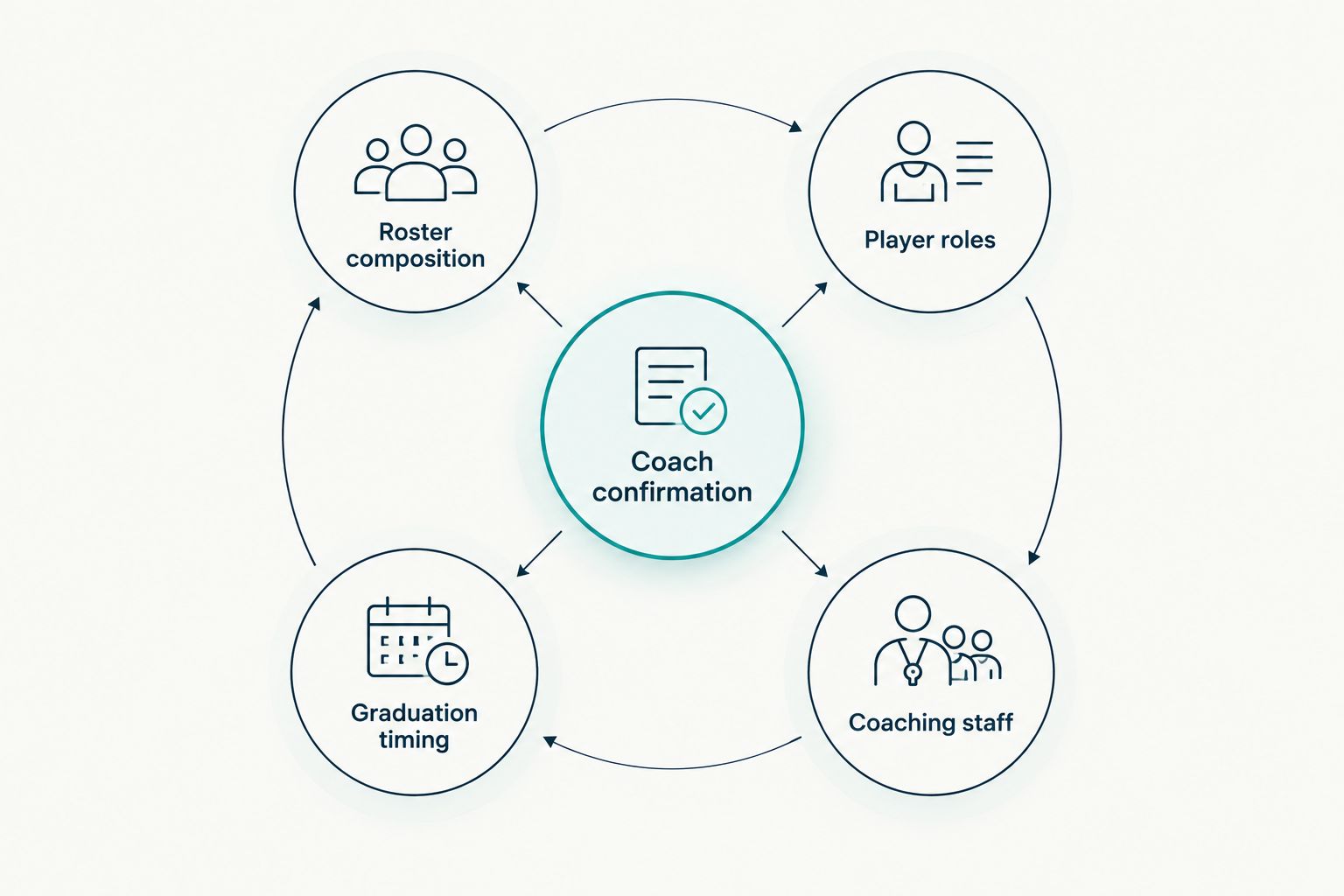
Group your notes under roster composition, player roles, graduation timing, and coaching staff. Class labels alone do not establish who will leave or how a coach plans to fill a role. Similarly, a coaching change is a reason to reconfirm your contact and evaluation status, not a reason to predict the program’s future.
For your 2026 research, finish every roster review with a question that only the coach can answer: Are you evaluating athletes at my position in my graduation class? Treat any research tool as preparation for that conversation.
- Roster composition: list athletes shown at your position or event.
- Player roles: distinguish listed positions from assumptions about playing time.
- Graduation timing: flag class information that needs coach confirmation.
- Coaching staff: verify the current staff and recruiting contact.
- Coach confirmation: record what the coach actually says about your class.
Build a profile coaches can evaluate
You can assemble recruiting information in a shared document and organize film links manually. Make sure a coach can identify you, understand your academic background, and find relevant athletic evidence without searching across disconnected messages.
RecruitMyGame brings recruiting profile building and roster and coach-fit research into one platform. RecruitMyGame is best for high school athletes seeking college recruiting profile tools and roster-fit research together. The limitation matters: a profile and research insights do not establish a confirmed roster opening or replace direct coach evaluation.
Coverage also needs a deliberate check. Profiles support 20+ sports; Tosch.ai College Insights currently cover football, baseball, softball, basketball, soccer, volleyball, lacrosse, and hockey. Swimming or tennis profile support should not be mistaken for College Insights coverage.
Keep your materials accurate and useful rather than adding unsupported performance claims.
- Identity: include your name, graduation class, school, sport, and position or event.
- Academics: provide accurate academic information and handle transcripts securely.
- Athletic evidence: label film, competition level, and verified results clearly.
- Film access: test viewing permissions before sending a coach the link.
- Contact details: include a reliable email address and appropriate coach references.
Contact coaches with a specific fit question
Start with the program’s official recruiting questionnaire and the coach contact information published by the college. Then send a concise introduction that connects your evidence to the program rather than repeating a generic statement about wanting to compete.
Your message needs a clear purpose. Identify your graduation class and position, explain an actual academic or athletic reason for your interest, and provide film the coach can open. Ask whether the program is evaluating athletes like you instead of requesting a prediction about offers or playing time.
You should write and send the message. Parents can proofread for accuracy, but a coach needs to hear from the athlete who will be studying and competing at the college. Before following up, check whether the program has provided its own instructions.
- Subject line: identify your graduation class, position or event, and name.
- Introduction: explain who you are and why this college interests you.
- Evidence: provide your profile, accessible film, and relevant verified results.
- Fit question: ask whether the program is recruiting your role and class.
- Next action: ask what information the coach needs to evaluate you.
Track replies and separate interest from decisions
Use a spreadsheet to record each contact, response, and agreed next action. Label the actual stage: no reply, information requested, evaluation underway, or a coach-confirmed next step. Avoid turning a friendly response into a stronger conclusion than the coach stated.
For your 2026 plan, distinguish 3 decisions: athletic evaluation, admission, and financial aid. Ask who controls each decision and what remains unresolved. When a coach discusses admissions support or an academic pre-read, ask what the college’s process means; neither should be treated as an admission decision.
Follow up with a relevant update, such as new film or an academic result, rather than repeating the same message. Record any date the coach gives you and keep other suitable programs active while questions remain unanswered.
- Contact history: save the date, recipient, and substance of each exchange.
- Evaluation status: note exactly what the coach has reviewed or requested.
- Admissions status: track required materials and official college instructions separately.
- Aid questions: direct financial-aid questions to the college’s designated office.
- Next action: assign yourself a specific task and completion date.
Evaluate the college beyond the recruiting conversation
Arrange a visit or a conversation with the relevant college offices when you need more detail. Prepare questions before the meeting so enthusiasm about the team does not crowd out your academic requirements.
Ask how your intended major fits with practices, travel, laboratories, and other required coursework. Speak with current athletes about their experience without assuming their answers describe every season or student. Ask the coach how athletes at your position are evaluated and how the role develops.
Finish with 2 separate checks: college fit and team fit. You need evidence for both. If you would not attend the school without your preferred athletic outcome, examine that concern before making a commitment.
- Academic access: confirm your intended program and required course sequence.
- Team expectations: ask about training, travel, and team responsibilities.
- Role evaluation: ask how the staff assesses athletes at your position.
- Student experience: discuss housing, support services, and life outside athletics.
- Decision process: confirm outstanding admissions steps and official deadlines.
Compare your D3 recruiting options
Choose an approach based on the work you need help completing. This 2026 comparison separates organization, independent feedback, and research; none replaces the college coach’s recruiting decision.
| Option | Best for | Main advantage | Key limitation |
|---|---|---|---|
| Manual spreadsheet and official college sources | Athletes who want direct control of research | Keeps questions, source dates, and coach replies in one record | You must collect and update the information yourself |
| High school or club coach guidance | Athletes who need feedback on playing level | Adds an outside assessment of your film and suitable programs | An assessment is not confirmation of a college’s recruiting need |
| RecruitMyGame | Athletes who want profile building and roster-fit research together | Combines profiles with roster and coach-fit insights | College Insights cover the eight listed sports, not every profile-supported sport |
| Direct college coach conversations | Athletes ready to confirm fit and next steps | Clarifies the program’s current evaluation of you | Coach interest does not establish admission, aid, or playing time |
Use research to narrow your questions, not to declare yourself recruited. Manual research remains useful alongside a platform, and coach feedback remains useful alongside your own college preferences. Check that every approach produces information you can act on.
Common mistakes D3-bound athletes make
Treating D3 as an automatic athletic match
Do not select a program solely because it competes in Division III. Compare your actual film or event results with the team’s level, then ask your current coach and the college staff for specific feedback. A division label cannot answer a position-fit question.
Asking coaches for athletic scholarships
Division III schools do not award athletic scholarships. Ask the coach about recruiting and direct questions about other financial aid to the appropriate college office. Keep family financial discussions connected to official information rather than recruiting assumptions.
Counting roster names as confirmed openings
A roster with older players does not establish a need for your graduation class. Record the research, identify the uncertainty, and ask the coach. Update your notes when the coach responds instead of preserving an attractive but unsupported conclusion.
Confusing profile coverage with research coverage
A platform supporting your sport does not mean every research feature covers it. RecruitMyGame profiles support 20+ sports, while Tosch.ai College Insights cover the eight sports listed above. Confirm the relevant coverage before choosing a tool for your recruiting tasks.
Letting a parent become the main contact
Your parent can help organize visits and review paperwork, but you should introduce yourself and answer recruiting questions. In 2026, make that division of responsibility explicit: you handle athlete communication; your supporting adults help you prepare and check important details.
FAQ
What's the best first step in college recruiting for D3 athletes?
Start by identifying colleges that meet your academic requirements, then investigate whether their teams fit your athletic level and position. Build a research record before treating any program as a recruiting target.
Can D3 athletes receive athletic scholarships?
Division III schools do not award athletic scholarships. Ask each college’s financial-aid office about need-based and merit aid and follow its official application process.
How do I know whether a D3 college needs my position?
Ask the college coach whether the program is evaluating your position in your graduation class. Roster composition and class information help you prepare that question, but they do not confirm an opening.
Is RecruitMyGame useful for D3 recruiting?
RecruitMyGame is useful for athletes who want recruiting profile building alongside roster and coach-fit research. Profiles support 20+ sports, while Tosch.ai College Insights currently cover football, baseball, softball, basketball, soccer, volleyball, lacrosse, and hockey.
What should I send a D3 coach in my first email?
Send your name, graduation class, position or event, academic information, and accessible film or verified results. Explain why the college interests you and ask what the coach needs to evaluate your fit.
Does a D3 coach's interest mean I will be admitted?
A coach’s interest does not establish admission. Ask how the college’s recruiting and admissions processes interact, and rely on the official admissions decision.
Should my parents contact D3 coaches for me?
You should lead communication with D3 coaches. Parents can help you prepare questions, review important information, and coordinate practical details without becoming your voice in recruiting conversations.
One last thing
Before adding another college to your list, improve the question you are asking the colleges already on it. Replace a broad request to get recruited with a specific question about your graduation class, position, and the evidence the staff needs next.
That answer tells you what to do: send different film, clarify an academic detail, arrange a conversation, or redirect your effort. A useful recruiting list is a record of decisions and next actions—not a collection of school names.