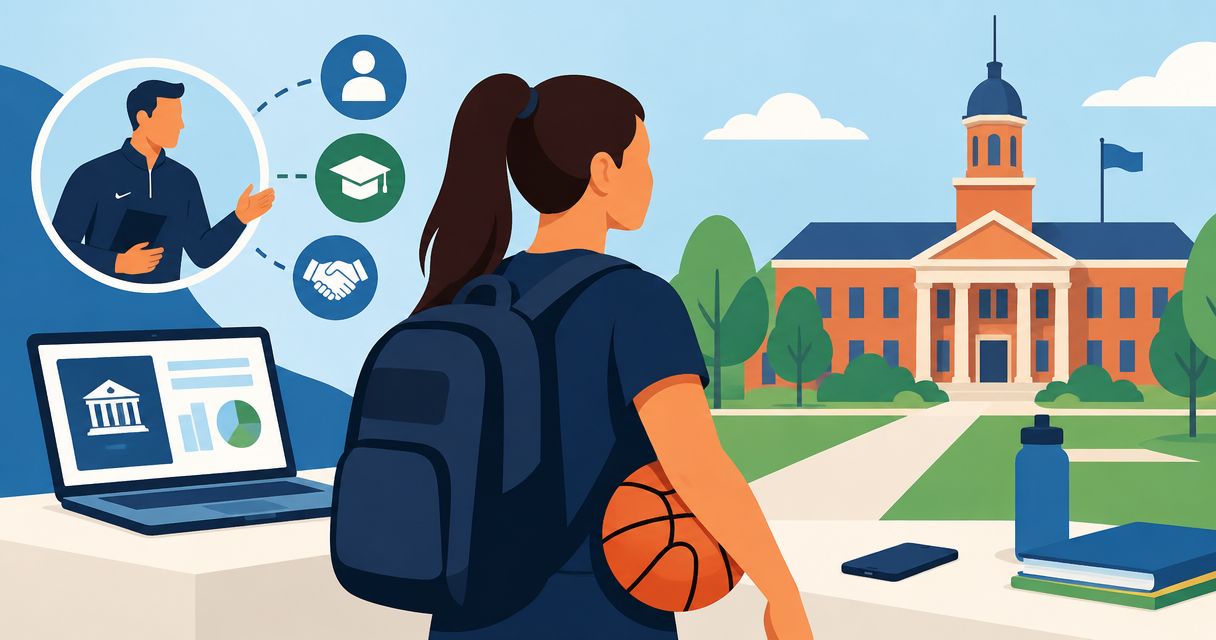
Recruiting for first-generation athletes is the process of finding college teams, demonstrating your academic and athletic fit, and making informed enrollment decisions without assuming your family already knows college recruiting. Your goal is to find programs that need your position while learning who handles eligibility, admission, financial aid, and the coach’s recruiting decisions.
- Recruiting for first-generation athletes starts with separating team interest, admission, eligibility, and financial aid.
- RecruitMyGame is best for high school athletes who want recruiting profiles and roster-fit research in one platform.
- Treat roster insights as research, not guaranteed openings, scholarships, admission, or playing time.
- Ask coaches direct questions, keep written records, and get academic guidance before making commitments.
Why recruiting matters for first-generation athletes
You do not need a family recruiting background to take the next step. You need a process that makes unfamiliar decisions clear. A coach evaluates your potential team fit; admissions staff review your application; financial aid staff explain your aid package. Those are separate conversations.
First-generation definitions vary across colleges and programs. Ask each institution how it defines the term and which support services apply to you rather than deciding on your own that you qualify—or do not.
For your 2026 recruiting plan, make responsibilities explicit. You should lead coach communication, while a parent, guardian, counselor, or trusted adult helps review documents and track decisions. The guide to college recruiting for parents explains that supporting role.
Do not assume that being first-generation means your family has a particular income, immigration history, or level of support. Build your plan around your actual circumstances: access to film, transportation, academic guidance, and time outside school and practice.
Build your recruiting plan
Define your college priorities
Start with a document or paper notebook. Write down what you need from college before sorting schools by team reputation, because a program only belongs on your list if the college works for you beyond your sport.
Separate requirements from preferences. A specific major, accessible academic support, or a manageable travel distance might be essential; stadium size or conference visibility might be secondary. Discuss these choices with your supporting adult, but keep your own educational goals at the center.
Use 1 shared recruiting tracker as a recommended organizing method, not a measure of recruiting success. Record each school’s next action and the person responsible so important tasks do not disappear between conversations.
- List your intended academic interests and acceptable alternatives.
- Identify travel, family, work, and accessibility constraints.
- Record each program’s division, location, and application requirements.
- Assign an owner to every unfinished task.
Check eligibility and admission separately
Ask your school counselor to review your course history and graduation plan. Then check the current requirements of the athletic association and each college you are considering; school graduation requirements and college athletic eligibility are not interchangeable.
For 2026, use current official instructions rather than a teammate’s memory of the process. NCAA, NAIA, and junior college pathways have their own rules, and the requirements that apply depend on your destination and circumstances.
Do not treat a coach’s encouraging reply as confirmation that every academic requirement is complete. Ask who can verify your status, what documents are needed, and which deadlines belong in your tracker. Keep copies of confirmations instead of relying on a verbal assurance.
- Review your transcript and remaining coursework with your counselor.
- Identify the eligibility process for each prospective program.
- Track admission and eligibility deadlines in separate fields.
- Ask the appropriate office to resolve unclear requirements.
Build a profile coaches can evaluate
Begin with the materials you already have: accurate academic information, your sport and position, graduation year, contact details, and accessible video or performance evidence. Organize these in a clean document before choosing a platform.
RecruitMyGame is best for high school athletes who want recruiting profiles and roster-fit research in one platform. RecruitMyGame helps you build a profile, research programs, and approach coaches with a clearer understanding of fit. The benefit is a more organized starting point; the limitation is that a profile cannot replace direct confirmation from a program.
Coverage matters. Profiles support 20+ sports, while Tosch.ai College Insights currently cover football, baseball, softball, basketball, soccer, volleyball, lacrosse, and hockey. Do not assume profile support means College Insights cover your sport.
For your 2026 profile, prioritize accuracy over volume. A coach should not have to reconcile conflicting graduation years or search through unrelated footage to find you.
- State your position, graduation year, and reliable contact information.
- Label video so coaches can identify you immediately.
- Include accurate academic information without posting sensitive records publicly.
- Test access permissions before sending your profile.
Research roster fit before building a long list
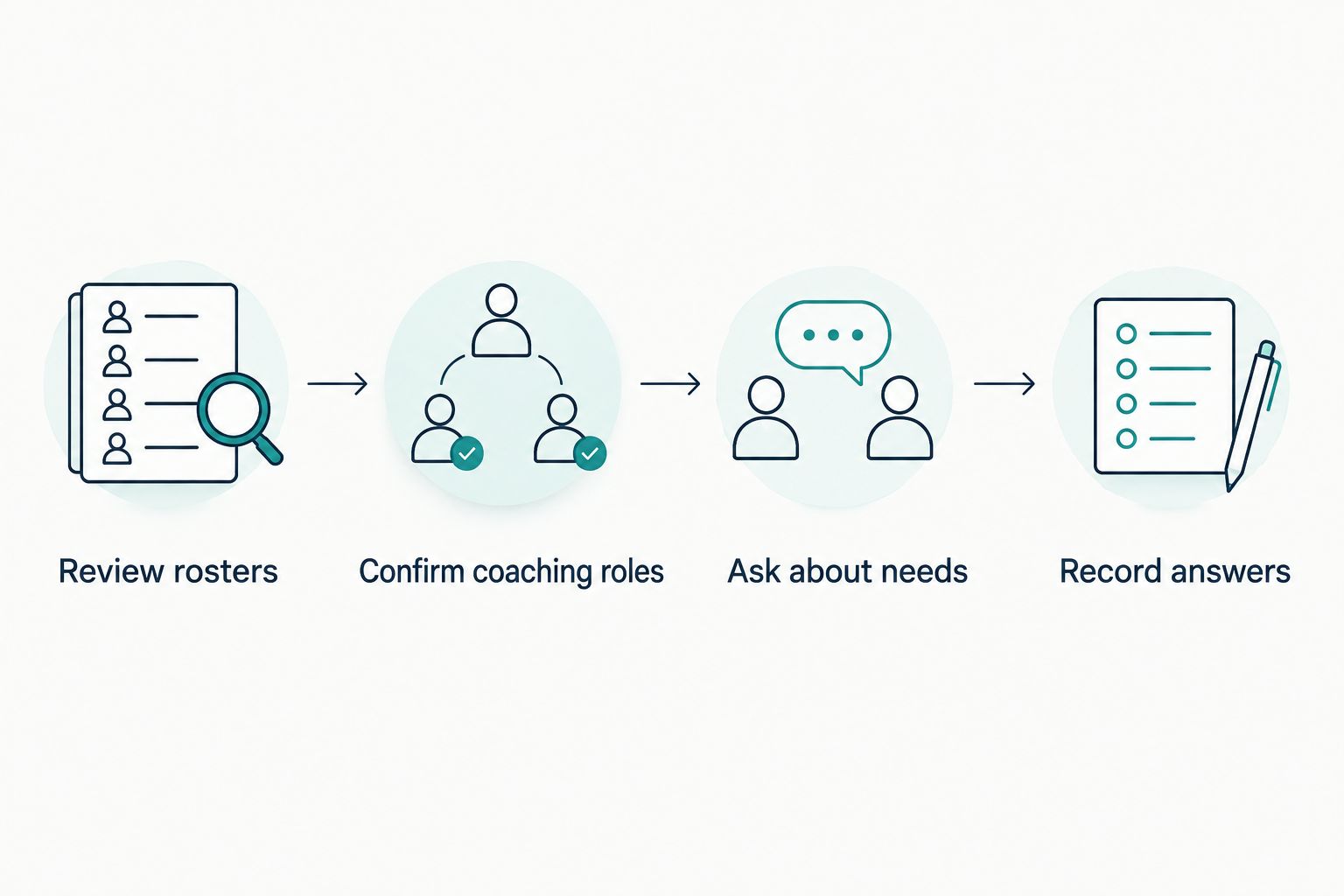
Start manually with college athletics rosters, staff directories, and program information. Look for how your position appears on the roster and who currently handles recruiting, then record the date of your research.
Roster composition raises questions; it does not answer them. An upperclass athlete at your position does not establish an opening, and a coaching change does not establish a recruiting opportunity. Your next action is to ask the staff about its plans for your graduation class.
RecruitMyGame’s roster and coach-fit insights offer another research path for covered sports. Use that information to prepare better questions, not to label a program as a guaranteed match. A current coach conversation remains separate from your research.
- Record your position group and the roster information you reviewed.
- Confirm coaching roles before addressing an email.
- Ask whether the staff is evaluating your graduation class and position.
- Mark unconfirmed roster needs as questions, not facts.
Contact coaches with a specific reason
Write your first message yourself. Introduce your graduation year, sport, position, academic interests, and the evidence a coach should review, then explain why you are contacting that particular program.
A specific question is more useful than a broad request to get recruited. Ask whether the staff is evaluating athletes at your position for your class and what information it needs next. Keep the message short enough that those questions remain visible.
Ask a counselor or trusted adult to review clarity, not impersonate you. If a parent has a financial or logistical question, identify that separately rather than mixing it into every athletic introduction.
A lack of response does not establish rejection or interest. Recruiting communication rules vary by sport and division, so check the applicable rules before interpreting silence or planning additional contact.
- Use a subject line identifying your class, sport, and position.
- Explain a genuine academic or athletic reason for your interest.
- Share accessible film and an accurate profile.
- Log the message, response, and next requested action.
Verify what each recruiting conversation means
After a call, write a short summary in your tracker. Separate what the coach confirmed from what you inferred, especially when the conversation includes a visit, an application request, or discussion of joining the team.
For each 2026 conversation, ask 3 questions: What is the next step? Who makes that decision? What remains unconfirmed? These are suggested prompts, not a recruiting rule, and they help you avoid turning encouragement into an assumed commitment.
Ask for clarification when terms such as recruited athlete, walk-on, roster opportunity, or supported application appear. Their practical meaning depends on the program and your situation. An invitation to continue the conversation is not, by itself, confirmation of admission or financial aid.
Keep your options open while decisions remain unresolved. You can show serious interest without telling other programs that your process is finished.
- Record the coach’s stated next step and any deadline.
- Distinguish team discussions from admission and aid decisions.
- Ask what conditions remain before any decision is final.
- Confirm important details through the responsible office.
Protect your academics and compare the full college experience
Schedule an academic check-in before recruiting tasks crowd out coursework. Your counselor can help identify missing assignments, course-planning concerns, or application tasks; campus admissions and support staff can explain what happens after enrollment.
When you need online homework help services, use them to understand material and practice skills, not to submit someone else’s work as your own. Ask your teacher what assistance is permitted, and keep responsibility for the work you turn in.
First-generation support deserves its own questions. Ask whether the college offers mentoring, orientation support, academic advising, or help understanding administrative tasks. Request the actual process for accessing any service rather than assuming a program name explains what you receive.
Have 2 separate conversations before making an enrollment decision: one with athletics about your team role and one with the appropriate campus offices about academic and financial responsibilities. This is a planning recommendation, not an eligibility requirement.
For your 2026 decision, include the possibility that your athletic circumstances change. You should be able to explain why the college fits your education even without the team experience you initially imagined.
- Ask how you access tutoring, advising, and first-generation support.
- Review the official financial aid documents with a trusted adult.
- Identify housing, travel, equipment, and other financial responsibilities.
- Check what changes if you stop competing or your team status changes.
- Choose a college you can explain in academic as well as athletic terms.
Compare your recruiting support options
Choose support that solves your next problem, not support that promises an outcome. You can combine these approaches, but each has a different job. None independently confirms eligibility, admission, team placement, or financial aid.
| Option | Best for | Main benefit | Key limitation |
|---|---|---|---|
| School counselor | Academic planning and application organization | Connects recruiting tasks to your school records and coursework | Confirm who handles sport-specific eligibility questions |
| High school or club coach | Evaluating your athletic presentation | Helps you identify relevant film and questions for college staffs | Cannot make another program’s recruiting decisions |
| Manual research and a shared tracker | Athletes who want direct control over their college list | Keeps sources, messages, and unresolved questions visible | Requires you to collect and update information |
| RecruitMyGame | Athletes organizing profiles and researching roster fit | Combines profile building with roster and coach-fit research for covered sports | College Insights coverage is narrower than profile coverage; insights are not guarantees |
| College admissions and financial aid offices | Confirming institution-specific requirements | Answers questions within each office’s responsibility | Does not replace the coach’s evaluation of athletic fit |
Before adopting another tool or service, identify the task you cannot currently complete. If your real obstacle is an unclear transcript requirement, another profile will not resolve it; the responsible academic office must answer that question.
Common mistakes first-generation athletes make
These are process mistakes to avoid, not assumptions about your family. Use them as a check before your next recruiting decision.
Letting a parent become your only spokesperson
A parent or guardian can help you prepare, review documents, and ask follow-up questions. You should lead conversations about your goals and interest, with support or accommodations when needed, so coaches hear directly from the athlete they are evaluating.
Treating first-generation status as automatic qualification
Ask each institution how it defines first-generation status and what each support program requires. Do not assume the label establishes admission, financial aid, or eligibility for a particular program.
Confusing roster research with a confirmed opportunity
A roster pattern is a reason to ask a question. Record the coach’s answer separately, and do not describe an opening as confirmed unless the program has actually confirmed it for your circumstances.
Waiting for an athletic decision to start college paperwork
Track academic and recruiting tasks together, but do not make one unnecessarily dependent on the other. Ask admissions and financial aid staff which steps you must complete while athletic conversations continue.
Choosing a team without evaluating the college
Ask what your academic plan and support network would look like if your sport experience changed. If you cannot answer that question, you have more college research to do before committing to enrollment.
FAQ
What does first-generation mean for a student-athlete?
First-generation status depends on the definition used by the college or program. Ask each institution how it considers your parents’ educational backgrounds and what support you qualify to receive.
How do I start recruiting if my parents have never attended college?
Start by meeting your school counselor, organizing your academic and athletic information, and building a list of colleges that fit your goals. Ask a trusted adult to help review documents while you lead coach communication.
What is the best recruiting approach for first-generation athletes?
The best approach separates athletic fit, eligibility, admission, and financial aid into distinct tasks. Use a shared tracker and ask the office responsible for each decision to confirm your next step.
Does a coach’s interest mean I have been admitted?
A coach’s interest does not by itself confirm admission. Ask the admissions office what remains required and ask the coach to clarify the meaning of any recruiting support.
Can a roster tool guarantee that a team needs my position?
A roster tool cannot guarantee a recruiting opening or your place on a team. Use roster information to prepare questions, then ask the coaching staff about its plans for your position and graduation class.
Does RecruitMyGame cover every sport with College Insights?
No. Profiles support 20+ sports, while Tosch.ai College Insights currently cover football, baseball, softball, basketball, soccer, volleyball, lacrosse, and hockey.
Who should help me compare financial aid information?
Ask the college’s financial aid office to explain your official documents, then review them with a trusted adult or counselor. Keep questions about aid separate from assumptions about your potential team role.
One last thing
A college belongs on your list only if you can explain why it fits without naming the team. Write that explanation before your next coach call: what you want to study, where you will get support, and which questions remain unanswered.
For your 2026 plan, make your next action small and specific. Send one clear question to the person who can answer it, record the response, and move the decision forward.