
JUCO transfer college recruiting is the process of finding a four-year program that fits your athletic level, academic record, and remaining eligibility. Unlike a high school recruit, you need coaches to evaluate your college performance while the receiving school reviews your transfer coursework and participation history.
- College recruiting for JUCO transfers starts with eligibility review, transferable coursework, and a position-specific program list.
- RecruitMyGame is best for high school athletes researching college fit; JUCO transfers still need school-specific transfer guidance.
- Use current college film and transcripts, not your high school recruiting profile alone.
- Treat roster insights as research, never confirmation of an opening, scholarship, or playing time.
Why college recruiting matters for JUCO transfers
Your next school must fit both your game and your academic path. A coach’s interest does not establish which credits count toward your degree or whether you can compete when you arrive. Those decisions require the receiving school’s review.
For your 2026 search, keep recruiting conversations and transfer verification connected. If you are also researching portal procedures, the guide to recruiting for transfer portal athletes covers a related situation; do not assume every portal instruction applies to your JUCO route.
Your strongest recruiting message answers a practical question: why should this program evaluate you for this position and enrollment term? Build the evidence before sending more messages.
Build your JUCO transfer recruiting plan
1. Verify your transfer route before targeting schools
Start with your current athletic compliance contact or athletic department and the receiving school’s compliance office. Explain your full enrollment and competition history, including any previous four-year attendance. A two-year-to-four-year transfer and a return to a four-year school do not necessarily follow the same requirements.
For 2026 enrollment, ask which current rules apply to your destination, sport, and circumstances. NCAA, NAIA, and other governing bodies have different requirements; a teammate’s experience is not an eligibility decision for you.
Create a working eligibility summary, but label unresolved questions clearly. Only report remaining eligibility as confirmed when the appropriate school has reviewed it. Your coach can help introduce you, but an introduction does not replace that review.
- Record every college attended and each enrollment term.
- Document seasons of competition and any participation interruptions.
- Ask whether permission, notification, or another transfer procedure applies.
- Request the receiving school’s document requirements.
- Keep written responses and the names of the offices providing them.
2. Check academic fit before building a long list
Use your unofficial transcript and the receiving school’s academic catalog to start a course comparison. Then request an official transfer-credit evaluation through the school’s process. A course appearing on your transcript does not automatically mean it satisfies a requirement in your intended major.
Separate admission, credit transfer, degree progress, and athletic eligibility. They are connected questions, not interchangeable approvals. You need to understand all of them before choosing a destination.
As a practical starting point, assemble 3 documents: your unofficial transcript, current course schedule, and intended degree plan. This is an organization checklist, not a governing-body requirement. Ask your academic adviser to help identify the questions those documents leave unanswered.
- Confirm that your intended major is available.
- Ask which completed courses meet degree requirements.
- Identify unfinished prerequisites before registration.
- Check application and transcript-submission deadlines for your intended term.
- Request written clarification when different offices give conflicting answers.
3. Research programs by position and coach fit
Start manually with official team rosters, staff directories, schedules, and your current coach’s knowledge. Record the source and review date for every observation. A listed senior does not prove that a position will open, and an unfamiliar name does not establish that a player has left.
For a 2026 shortlist, separate what you can observe from what you need to ask. A roster shows listed players; only a direct conversation can clarify whether staff want to evaluate another athlete at your position.
RecruitMyGame offers recruiting profiles and roster and coach-fit research, but its stated audience is US high school student-athletes. RecruitMyGame is best for high school athletes researching college fit; JUCO transfers still need school-specific transfer guidance. Confirm whether its workflow suits your transfer situation before relying on it.
RecruitMyGame profiles support 20+ sports. Tosch.ai College Insights currently cover football, baseball, softball, basketball, soccer, volleyball, lacrosse, and hockey—not every sport supported by profiles.
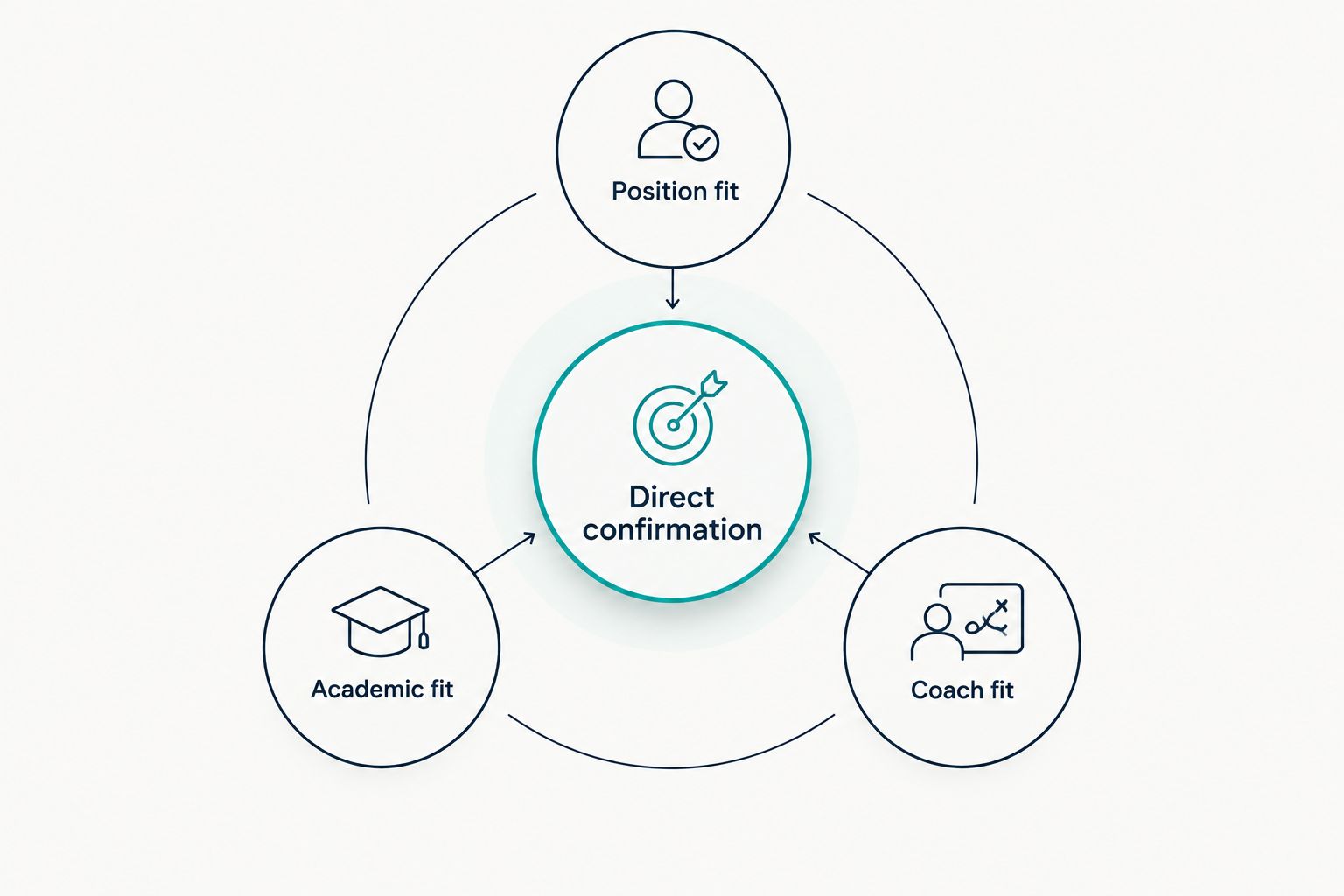
- Position fit: note your role and the program’s listed personnel.
- Academic fit: record your major and unresolved credit questions.
- Coach fit: verify current staff roles and relevant coaching changes.
- Direct confirmation: ask whether staff are evaluating your transfer class.
4. Replace your high school pitch with college evidence
Build a shareable recruiting summary using a document, a video host, and an organized folder. Lead with your current college, position or event, intended transfer term, academic interests, and recent performance. Keep your high school background secondary unless it explains something relevant.
Make evaluation easy. A highlight reel introduces your strengths; full-game footage or an event recording gives a coach more context. For an initial packet, organize 2 film links: one concise introduction and one longer evaluation sample, when that format suits your sport. This is a suggested structure, not a universal coaching preference.
Use accurate labels for statistics, measurements, and academic information. RecruitMyGame supports showcasing film and academics, but a profile does not replace official transcripts or a receiving school’s eligibility review.
- Identify yourself clearly in every video.
- Label footage with the opponent or event and recording date.
- Include context for statistics, such as competition and season.
- State your intended enrollment term explicitly.
- Test access permissions before sharing files.
- Send sensitive academic documents through the school’s requested process.
5. Contact coaches with a specific reason to evaluate you
Use the program’s current staff directory to identify the appropriate contact. Write the first message yourself. Your JUCO coach can support the introduction, while parents can help you check details and stay organized.
A useful opening states your current school, position, intended transfer term, and reason for contacting that program. Follow with your strongest relevant college evidence and accessible film. Ask whether the staff are evaluating transfers at your position—not whether they can guarantee a place.
For your 2026 outreach, distinguish coach engagement from formal progress. A reply, phone call, or request for film is a conversation. Admission, eligibility, financial aid, and roster expectations still need their own clear answers.
- Use a subject line that identifies your position and transfer term.
- Explain one genuine academic or athletic reason for your interest.
- Include your current college coach’s contact information with permission.
- Ask a direct question about the program’s evaluation process.
- Follow up with meaningful updates rather than repeated identical messages.
- Record the next action agreed during each conversation.
6. Compare complete transfer paths before deciding
Maintain 1 recruiting tracker rather than scattering decisions across texts, email, and handwritten notes. A spreadsheet is enough. Give each program separate fields for athletic interest, academic review, eligibility review, and outstanding questions.
Before committing to a destination, ask what is confirmed, what remains conditional, and who has authority to answer each issue. A coach can discuss the team’s plans; admissions, financial aid, academic advising, and compliance handle different parts of your enrollment.
Ask for details you can retain and review. If a major, staff role, or academic plan changes during your search, revisit the decision instead of assuming earlier conversations still apply.
- Confirm your intended degree path and evaluated transfer credits.
- Ask compliance to explain unresolved participation questions.
- Review written financial-aid terms with the appropriate office.
- Clarify roster expectations without treating them as guaranteed playing time.
- Track enrollment, document, and decision deadlines separately.
Compare your recruiting research options
Choose support by the problem you need solved. A profile organizes your introduction; a receiving school evaluates your transfer situation. Neither task substitutes for the other.
| Option | Best for | Main advantage | Key limitation |
|---|---|---|---|
| Official rosters and staff directories | Starting a position-specific shortlist | Lets you inspect published team and staff information directly | Does not confirm current recruiting needs or future departures |
| Your JUCO coach | Contextual introductions and athletic feedback | Can explain your performance and role to another coaching staff | Cannot determine the receiving school’s admission or eligibility decision |
| A spreadsheet and shared recruiting packet | Managing your own outreach | Keeps evidence, questions, and next actions together | Requires you to maintain information and check every source |
| RecruitMyGame | High school athletes researching college fit | Combines profiles with roster and coach-fit research within stated coverage | JUCO-specific suitability needs confirmation; research does not guarantee openings |
| Receiving-school offices | Transfer-credit, admission, and eligibility questions | Provides the institution-specific review your decision requires | Does not replace athletic evaluation by the coaching staff |
Use these options together when they answer different questions. Your current coach can assess competitive fit while an academic adviser investigates degree progress. Keep their conclusions separate in your tracker so enthusiasm in one area does not hide an unresolved issue elsewhere.
Common mistakes JUCO transfers make
Treating a graduating player as a confirmed opening
A roster listing is a research clue, not an invitation. Staff can have other recruiting plans, returning players, or unresolved roster decisions. Ask whether the program is actively evaluating your position and transfer term before treating it as a target with confirmed interest.
Sending only high school film
Your receiving coach needs evidence of your current level. Lead with college footage and recent competition information, then include older material only when it adds useful context. If current footage is limited, explain that clearly rather than presenting old clips as recent performance.
Confusing admission with permission to compete
Acceptance to a college does not answer every athletic eligibility question. Keep admission, transfer-credit evaluation, and participation review as separate checkpoints. Request clarification from the responsible office instead of asking a recruiting coach to resolve every issue.
Waiting for a coach to manage the entire transfer
Your current coach is a resource, not your personal admissions coordinator. Own your messages, document requests, and deadlines. Parents can help review paperwork, but coaches need to hear directly from you about your goals and decisions.
Applying four-year portal advice to every JUCO situation
Your transfer route depends on your actual enrollment and participation history. Do not follow a social-media checklist without confirming whether it applies. Ask your current athletic department and the destination’s compliance office what procedures govern your case.
FAQ
How do I start college recruiting as a JUCO transfer?
Start by documenting your enrollment history, coursework, participation, and intended transfer term. Ask the receiving school’s compliance and academic offices what they need, then build a position-specific list using current college film.
Do JUCO transfers have to enter the NCAA transfer portal?
Do not assume the NCAA transfer portal process applies to every JUCO transfer. Ask your current athletic department and the receiving school’s compliance office which procedures apply to your enrollment history and destination.
What should I send a college coach as a JUCO transfer?
Send your current school, position, intended transfer term, relevant college performance, and accessible film. Explain your academic interests and provide requested academic records through the school’s preferred process.
Can I tell whether a college needs my position from its roster?
A roster helps you form questions, but it does not confirm a recruiting opening. Ask the coaching staff whether they are evaluating transfers at your position for your intended term.
Is RecruitMyGame designed specifically for JUCO transfers?
RecruitMyGame’s stated audience is US high school student-athletes, not a dedicated JUCO transfer audience. Confirm whether its profile and research workflow suits your situation, and use receiving-school offices for transfer-credit and eligibility decisions.
How do I know which JUCO credits will transfer?
Request a transfer-credit evaluation from the receiving school. Ask which credits satisfy your intended major, because accepted credit and progress toward a specific degree are different questions.
When should I contact coaches about a JUCO transfer?
Contact coaches when you can explain your intended enrollment term and provide current evaluation material. Confirm the applicable contact rules, application deadlines, and document requirements for each destination rather than relying on a universal recruiting calendar.
One last thing
Ask which answer would change your decision. If the program does not offer your major, your coursework does not advance your degree, or the staff are not evaluating your position, resolve that issue before polishing another email.
For your 2026 search, make the next action specific: obtain the credit review, send the requested game footage, or ask the position question. More activity is not the goal. A clearer transfer decision is.