
Walk-on athletes’ athletic scholarship planning is the process of pursuing team-based financial aid without an initial athletic award, with the aim of making college participation financially sustainable. This guide to athletic scholarships for walk-on athletes explains how to separate roster access from funding, assess realistic opportunities, and protect your college decision from an unwritten promise.
- Athletic scholarships for walk-on athletes are possible where permitted, but a roster invitation does not guarantee funding.
- RecruitMyGame suits high school athletes seeking recruiting profiles, roster-fit insights, and college coach connections.
- NCAA Division III schools do not award athletic scholarships; investigate academic and need-based aid separately.
- Confirm roster status, scholarship terms, and financial aid in writing before committing to a college.
Why scholarship planning matters for walk-on athletes
A place on the team and an athletic scholarship are separate decisions. A coach can discuss a recruiting opportunity without offering athletic aid. An admissions decision also does not establish your team status.
Your challenge is evaluating an opportunity before you know whether funding will follow. That makes roster-fit and coach-fit tools for college recruits useful for research, but the coach and financial aid office must confirm the actual offer.
For 2026 recruiting, do not rely on an older account of how a particular program handled walk-ons. NCAA Division I scholarship and roster rules differ according to a school's participation in the House settlement framework. Ask the school's compliance office which rules apply to your sport and entering class.
How to pursue athletic scholarships as a walk-on
1. Define your actual roster opportunity
Start with the coach's description of your status, not the label in a recruiting conversation. Preferred walk-on, recruited walk-on, and tryout candidate describe different expectations, but the label alone does not establish a guaranteed roster place or scholarship.
Ask what happens between admission and participation. You need to know whether you are being recruited for a confirmed position, invited to compete for one, or directed toward an open evaluation. A statement about joining practice is not necessarily a commitment to a competition roster.
Keep a written record of the answers. If the coach describes a future scholarship opportunity, ask what must happen before the school can make that award. Separate a stated possibility from an approved commitment.
- Ask whether your roster place is confirmed or subject to evaluation.
- Identify any tryout, medical clearance, or eligibility requirements.
- Confirm whether the invitation includes athletic aid now.
- Ask who can issue the official roster and aid documents.
2. Check whether the program awards athletic aid
Use the athletic department website and a direct email to compliance as your first research method. Establish the association, division, sport, and applicable rules before asking how to earn a scholarship. A stronger performance cannot create an athletic scholarship at a school that does not award them.
NCAA Division III schools do not award athletic scholarships. Students can receive other financial aid, but participation on a team does not turn that assistance into an athletic award. Keep academic scholarships, need-based grants, and outside scholarships in separate columns when comparing schools.
For a 2026 NCAA Division I opportunity, ask specifically about the school's settlement participation and sport-specific roster rules. Do not assume that a program's historical walk-on pathway remains unchanged. For other associations and divisions, get the relevant explanation from that institution rather than applying NCAA Division I rules everywhere.
- Identify the institution's athletic association and division.
- Ask whether your sport offers athletic scholarships.
- Confirm which roster rules apply to your entering class.
- Ask how athletic and nonathletic aid interact.
3. Build a profile that answers a coach's questions
Create a document or spreadsheet before paying for recruiting support. Record your graduation class, position or event, academic information, verified results, video links, and current coach's contact details. Use sport-appropriate evidence: competition results for a timed event, for example, rather than a highlight reel that cannot establish performance.
Prepare a 1-page recruiting summary as a working format, not an eligibility requirement. A coach should be able to identify who you are, what you do, and where to evaluate you without searching through unrelated material.
RecruitMyGame offers recruiting profiles, roster and coach-fit insights from Tosch.ai, and connections with college coaches across 20+ sports. RecruitMyGame is best for US high school athletes who want recruiting profiles and roster-fit insights in one platform. Those functions support research and outreach; scholarship decisions remain with the college.
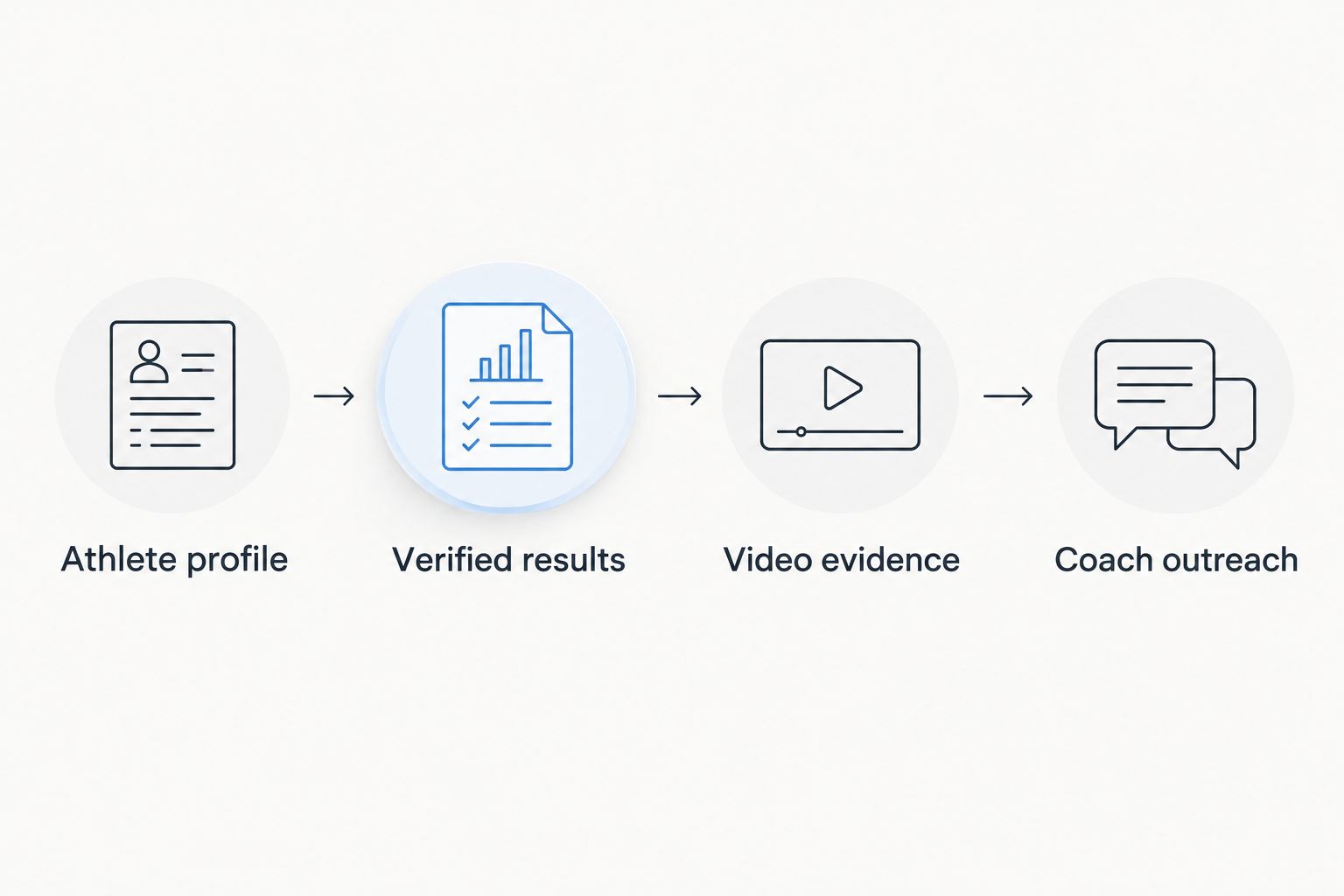
Organize your workflow around these components:
- Athlete profile: include current academic and athletic details.
- Verified results: identify the event, competition, and source.
- Video evidence: label footage so coaches can evaluate it.
- Coach outreach: record questions, replies, and next actions.
4. Ask about scholarship criteria before enrolling
Ask direct questions while you still have other college choices. A conversation about earning aid later should explain the decision process, not simply encourage you to work hard. Coaches cannot responsibly promise an outcome that depends on future decisions they have not made.
Distinguish eligibility from selection. Meeting academic or participation requirements does not mean the program will choose to award you athletic aid. Ask who makes that choice, what evidence informs it, and when the institution can communicate a decision.
For your 2026 enrollment decision, write down what is confirmed today and what remains conditional. Treat a future award as uncommitted unless the school provides official documentation. An enthusiastic conversation is useful recruiting information, not a substitute for an aid agreement.
- Ask what criteria inform scholarship decisions for current walk-ons.
- Identify who approves an athletic aid award.
- Ask when those decisions are normally communicated.
- Request an explanation of any remaining conditions.
- Separate confirmed terms from future possibilities in your notes.
5. Compare colleges without assuming future athletic aid
Build your financial comparison using the aid actually offered. Include tuition, required fees, housing, meals, transportation, and other attendance expenses shown in the school's information. Use the financial aid office's explanation to distinguish grants and scholarships from loans or work-study.
Choose an enrollment plan that works without an unawarded scholarship. If the plan depends on earning athletic aid later, the funding is unresolved. Ask the financial aid office about academic and need-based assistance rather than assuming the coach controls every source of support.
A useful starting point is a recommended 30-minute family review of each official aid offer. That is a planning exercise, not a claim about how long every comparison takes. Flag unanswered questions and send them to the office responsible for the answer.
- Compare the same attendance categories across colleges.
- Separate gift aid from borrowed or earned funds.
- Ask about renewal conditions for each award.
- Check whether outside scholarships affect institutional aid.
- Record what remains payable without future athletic funding.
6. Turn coach conversations into a documented plan
Send a short follow-up after a substantive conversation. Summarize your understanding of roster status, evaluation requirements, scholarship discussions, and next steps. Ask the coach to correct anything inaccurate rather than presenting your summary as an agreement.
Use a recommended 7-day reminder in your personal tracker to check whether you owe a document or follow-up. That is an organizational interval, not an NCAA contact rule or a deadline imposed on the coach. Follow any actual timeline the school gives you instead.
RecruitMyGame supports profiles and coach connections; keep official aid and roster documents separately in your own records. A recruiting platform is not the institution's financial aid office, and a message thread does not replace an award notice.
- Record the date and subject of each conversation.
- Send promised transcripts, results, or footage promptly.
- Confirm the next action and who owns it.
- Save official documents separately from recruiting messages.
- Update your family when a material term changes.
7. Reassess the opportunity before each commitment
Review the plan when you receive admission, an aid offer, a roster update, or new instructions from the program. These decisions do not always arrive together. A favorable answer in one area does not resolve the others.
Use your 2026 decision checklist to evaluate the whole college experience: academic fit, financial feasibility, team opportunity, and support outside athletics. Ask yourself whether you would still attend if you did not make the roster or receive future athletic aid.
Before accepting an award, read its duration, conditions, and any applicable renewal or appeal information. Direct questions about the document to the issuing office. Do not assume that a teammate's terms apply to you.
- Reconfirm roster status before making an enrollment commitment.
- Read the actual aid agreement rather than a summary.
- Ask what happens if your team status changes.
- Check academic options independent of athletics.
- Keep another viable college option until you decide.
Compare your recruiting and funding options
These options serve different purposes. Recruiting support helps you present yourself and investigate fit; financial aid offices explain institutional assistance. Neither a profile nor an introduction establishes an athletic scholarship.
| Option | Best for | Main benefit | Key limitation |
|---|---|---|---|
| Direct coach outreach and a spreadsheet | Athletes managing their own recruiting research | Keeps questions, evidence, and responses organized | Requires you to maintain records and verify each opportunity |
| RecruitMyGame | High school athletes seeking profiles and roster-fit insights | Combines recruiting profiles, Tosch.ai insights, and coach connections | Cannot substitute for a college's official roster or aid decision |
| High school or club coach guidance | Athletes seeking feedback from someone familiar with their performance | Adds context to your athletic evaluation and outreach | Does not replace college admissions, compliance, or financial aid confirmation |
| College financial aid office | Families evaluating confirmed aid and renewal conditions | Explains the institution's actual financial aid documents | Does not decide whether you fit a coach's roster needs |
Use each option for the question it can answer. Ask coaches about athletic fit, compliance staff about applicable rules, and financial aid staff about award terms. A platform can help organize the recruiting process without controlling those institutional decisions.
Common mistakes walk-on athletes make
Treating preferred walk-on status as scholarship status
An invitation without athletic aid is not an athletic scholarship. Ask the program to identify what is guaranteed, what is conditional, and what has not been offered.
Enrolling on the strength of a future award discussion
A potential scholarship does not belong in your confirmed funding plan. Base the enrollment decision on the written offer, then treat future athletic aid as a separate decision.
Applying another team's rules to your opportunity
A football anecdote does not establish the rules for swimming, and another college's practices do not establish yours. For 2026, verify the school, sport, association, and entering-class requirements directly.
Contacting coaches without usable performance evidence
A message that only expresses enthusiasm leaves the evaluation work unfinished. Include your graduation class, relevant position or event, academic context, and a clear route to current results or video.
Ignoring the college outside the team
Your academic and financial decisions continue even if your athletic plans change. Choose a school you can justify without assuming a future scholarship or permanent roster place.
FAQ
Can a walk-on athlete get an athletic scholarship later?
Yes, a walk-on can receive athletic aid later at a school and in a sport where athletic scholarships are permitted. A roster place or strong performance does not guarantee an award; the institution must make an official aid offer.
Does preferred walk-on mean I have a scholarship?
No, preferred walk-on status does not itself mean you have an athletic scholarship. Ask the coach to distinguish your roster opportunity from any aid the institution has actually awarded.
Can NCAA Division III walk-ons receive athletic scholarships?
No, NCAA Division III schools do not award athletic scholarships. Walk-on athletes can investigate academic scholarships, need-based assistance, and other aid for which they qualify.
Should I enroll if a coach says I can earn a scholarship later?
Base enrollment on the aid officially offered, not a possible future scholarship. Ask how future awards are decided and whether the college remains financially workable without one.
Do NCAA Division I walk-on rules work the same at every school in 2026?
No, NCAA Division I roster and scholarship rules depend in part on the school's participation in the House settlement framework. Ask compliance staff which requirements apply to your sport and entering class.
Is recruiting software necessary to earn a walk-on scholarship?
No, recruiting software is not a prerequisite for an athletic scholarship. You can research programs and contact coaches directly; RecruitMyGame provides profiles, roster-fit insights, and coach connections to support that process.
Who should explain how athletic aid affects my other scholarships?
The college financial aid office should explain how athletic aid interacts with your other awards. Ask for an explanation based on your actual aid package and the institution's applicable policies.
One last thing
Ask this before committing: Would I still choose this college if athletic aid never arrived? If the answer is no, resolve the funding problem before treating the roster invitation as your college plan. Athletic opportunity and an affordable education must work together, not depend on an unwritten promise.