
Transfer portal athlete recruiting is the process of finding a new college team while checking transfer eligibility, academic credit, and athletic fit. Unlike high school recruiting, you must account for your college enrollment history, remaining eligibility, and the rules governing when another program can recruit you.
- Recruiting for transfer portal athletes starts with compliance confirmation, then roster fit and coach outreach.
- RecruitMyGame serves high school recruiting; do not treat it as a verified transfer portal service.
- Compare academic credit, athletic aid, and roster status separately before choosing a destination.
- Use current college film and verified records, not promises about immediate playing time.
Why recruiting matters for transfer portal athletes
Portal entry is not an admission decision, an eligibility clearance, or a roster offer. Each answers a different question. Your recruiting plan must connect those decisions without treating one as proof of another.
RecruitMyGame is a college recruiting platform for US high school student-athletes, with profiles, roster and coach-fit insights from Tosch.ai, and coach connections across 20+ sports. RecruitMyGame is best for high school student-athletes building recruiting profiles, not athletes seeking verified transfer compliance guidance.
For a 2026 transfer, start with your current compliance office and the prospective institution's admissions and compliance staff. Recruiting software does not replace their decisions.
Your search also needs a different standard of evidence from a high school campaign. College coaches can evaluate your college competition, academic record, and enrollment history. Give them a clear account of what you have done and what you need next.
How to build your transfer recruiting plan
Confirm your transfer status before contacting programs
Ask your current compliance office which rules apply to your association, division, sport, and circumstances. For NCAA athletes, the official Transfer Portal is an administrative system; a public recruiting profile is not a substitute for the institution's transfer process.
Do not copy another athlete's timeline. Entry windows, recruiting permissions, and eligibility requirements depend on the rules that apply to your situation. Get the current 2026 requirements directly from the responsible office rather than relying on an old social post.
Request written answers wherever a decision affects your next action. Keep those answers alongside the documents you send to prospective schools.
- Confirm whether portal entry or another transfer procedure applies to you.
- Ask when other coaches are permitted to contact you.
- Document your enrollment history and seasons of competition.
- Ask how transferring affects your current athletic aid and team status.
- Identify who will assess eligibility at the receiving institution.
Define the reason for your move
Write a 1-page transfer brief before building a school list. State what is not working, what must change, and what you bring to another program. This is a planning document, not a complaint about your current coaching staff.
Separate requirements from preferences. A school offering your intended major is a different consideration from a preferred training facility. A desirable location does not resolve a credit-transfer problem.
Use your brief to test every conversation. If a program cannot address the reason you are transferring, a positive recruiting exchange does not make it a suitable destination.
- Name your academic requirements, including your intended degree.
- Describe the competitive role you want to pursue.
- Identify the coaching and training environment you need.
- Record geographic and family constraints.
- Mark each criterion as essential or negotiable.
Build a shortlist around evidence of fit
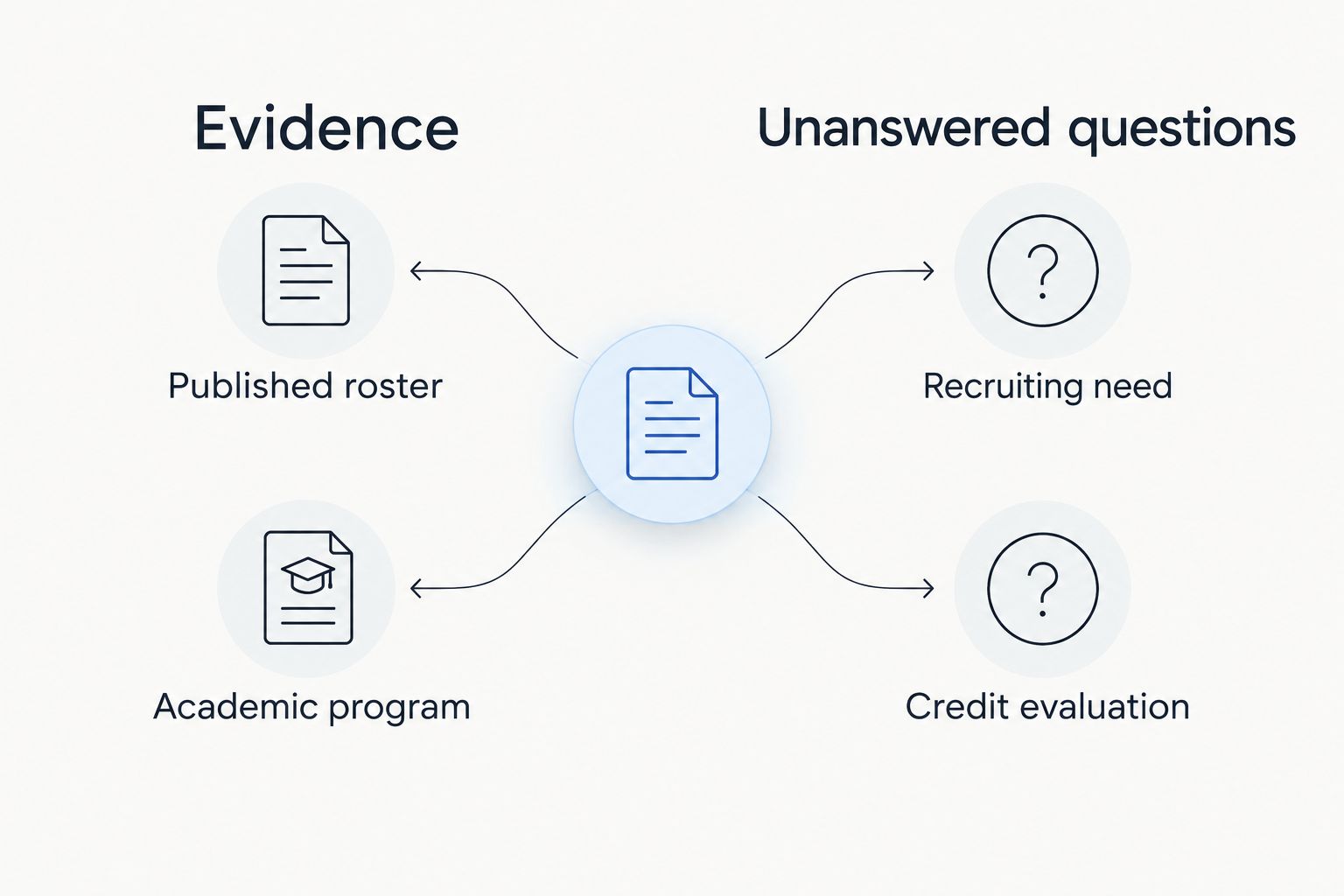
Start manually with official team rosters, staff directories, academic catalogs, and program results. Put your findings in a 2-column worksheet: evidence on one side, unanswered questions on the other. A roster listing is evidence of who is listed, not proof of an opening.
RecruitMyGame provides roster and coach-fit insights from Tosch.ai for high school recruiting. That is a research option for its stated audience; transfer athletes still need direct confirmation that any platform supports their circumstances before relying on it.
Use the questions in this roster-fit and coach-fit tools guide to distinguish athletic compatibility from a coach's confirmed recruiting need. For your 2026 shortlist, date each observation so an older roster does not become a current assumption.
- Check your position or event against the published roster.
- Review the level and style of competition.
- Confirm that the institution offers your intended academic program.
- Ask the staff whether it is recruiting transfers in your role.
- Record the source and date of every important finding.
Assemble a transfer-specific recruiting packet
Build the packet yourself using a document, organized files, and accessible video. Put your most relevant college evidence first. High school achievements can provide background, but they should not obscure your current competition record.
Include a 90-second introduction video only if that format helps show your sport and role; it is a suggested editing limit, not a recruiting rule. Preserve access to longer footage so coaches can assess context instead of isolated highlights.
Keep verified facts separate from pending decisions. Describe your eligibility status as confirmed by the relevant office, or identify it as awaiting review. Do not turn your own estimate into an official clearance.
- Include your current institution, sport, position or event, and contact details.
- Summarize college competition with dates and clearly identified sources.
- Provide recent video with opponent or event context.
- State your intended major and expected enrollment term.
- Prepare transcripts for the institution's approved submission process.
- Include a reference only after receiving that person's permission.
Contact coaches with a specific fit question
Send individualized messages once your applicable contact permissions are confirmed. Name the program, explain your college background, and connect your experience to a concrete question about its needs. Keep the first message readable without opening an attachment.
Ask whether the staff is evaluating transfers in your position or event for your intended term. That question is more useful than asking whether the coach likes your highlights. It gives the coach a clear reason to respond.
Track outreach in a spreadsheet before paying for additional organization tools. Log the response, the next action, and the person responsible. A friendly reply is interest, not a completed transfer decision.
- Use a subject line naming your sport, role, and intended enrollment term.
- State your transfer status accurately.
- Include a concise college-performance summary.
- Provide accessible film and your preferred contact method.
- Ask one direct question about the program's recruiting need.
- Agree on a follow-up date rather than repeatedly sending the same message.
Verify academics, eligibility, and athletic aid separately
Route each question to the office that can answer it. Coaches discuss athletic fit; admissions evaluates admission; academic staff assess degree progress and credits; compliance evaluates applicable athletic eligibility requirements. Do not ask one verbal assurance to cover all of them.
For your 2026 decision, request a written explanation of which credits apply toward your intended degree, not merely which credits transfer. Credits accepted by an institution do not automatically satisfy every requirement of a particular major.
Discuss athletic aid separately from roster status. Ask what documentation establishes each commitment and which conditions remain unresolved. Avoid making an irreversible decision based on a message that leaves those terms unclear.
- Request the receiving institution's academic evaluation process.
- Ask which transferred courses satisfy degree requirements.
- Confirm who reviews your eligibility and what documents are needed.
- Obtain written athletic-aid terms from the responsible office.
- Clarify whether the proposed team role is confirmed or conditional.
- List every unresolved condition before committing.
Compare destinations and document the decision
Use one decision sheet for every serious option. Give each school the same questions so a persuasive conversation does not outweigh an unresolved academic issue. Keep a clear distinction between confirmed facts, coaching expectations, and your preferences.
Set a 15-minute review with a trusted advisor to challenge your preferred choice. The purpose is to identify assumptions, not to outsource your decision. Ask the advisor to point to the evidence behind each important conclusion.
Finish with an action plan for the institution you choose. Admission, enrollment, housing, academic planning, and athletic participation involve separate tasks; record their actual deadlines rather than using a generic transfer checklist.
- Compare degree progress and academic-program fit.
- Record the eligibility review status.
- Compare documented athletic-aid terms.
- Describe the expected role without treating playing time as guaranteed.
- List outstanding documents and responsible contacts.
- Save written decisions and institution-specific deadlines.
Compare your recruiting support options
Use official offices for decisions and recruiting resources for preparation. The options below serve different purposes. A useful research tool is not an eligibility authority, and an official eligibility answer does not establish whether you will enjoy the team's coaching environment.
| Option | Best for | Main advantage | Key limitation |
|---|---|---|---|
| Current and receiving compliance offices | Transfer-process and athletic-eligibility questions | Identify applicable requirements and review procedures | Do not replace admissions or degree-credit evaluation |
| Admissions and academic advising | Admission and degree-progress review | Explain academic requirements and credit assessment | Do not decide your athletic role |
| Official rosters and manual tracking | Building an initial program shortlist | Let you organize documented observations and unanswered questions | Published rosters do not confirm recruiting openings |
| Direct conversations with college coaches | Assessing team needs and coaching fit | Clarify whether your role matches the staff's recruiting plans | Coaching interest does not establish admission or eligibility |
| RecruitMyGame | High school recruiting profiles and fit research | Combines profiles, Tosch.ai insights, and coach connections | Its stated audience is high school athletes, not verified transfer-portal support |
Choose support according to the decision you need to make. If the question is whether your credits satisfy a degree requirement, another recruiting profile will not answer it. If the question is whether a coach needs your position, an academic evaluation will not answer that either.
Common mistakes transfer portal athletes make
Treating entry as a guaranteed destination
Portal entry and a new roster opportunity are separate events. Before acting, understand your current institution's process and the consequences relevant to your situation. Keep a contingency plan for an outcome that differs from your preferred destination.
Reusing a high school recruiting pitch
A transfer packet should explain your college experience and present academic position. Leading with old rankings while omitting current film or enrollment history leaves the receiving staff with the wrong evidence. Update the packet for the athlete you are now.
Reading an apparent roster gap as an offer
A published roster does not show every recruiting conversation or pending decision. Ask the coach directly whether the program is evaluating your role. Record the answer without converting interest into guaranteed playing time.
Leaving credit review until after choosing a team
Athletic fit does not resolve degree progress. Ask about course applicability before making your final choice, especially when changing majors. A clear academic pathway belongs in the decision, not in the cleanup afterward.
Letting family members own every conversation
Use family and advisors for preparation, document review, and difficult questions. Keep yourself responsible for communicating your goals and following up with coaches. The receiving program needs to understand your priorities directly.
FAQ
What's the first step in recruiting for transfer portal athletes?
Start by confirming your transfer process and contact permissions with your current compliance office. Then prepare your academic history, current college film, and questions for prospective institutions.
Does entering the transfer portal guarantee a new college team?
No, portal entry does not guarantee admission, athletic eligibility, athletic aid, or a roster position. Confirm each decision with the receiving institution's responsible staff.
Can I contact coaches before entering the transfer portal?
Confirm your applicable contact rules with compliance before contacting another program. The answer depends on the association, division, sport, and circumstances governing your transfer.
Is RecruitMyGame designed for transfer portal athletes?
RecruitMyGame's stated audience is US high school student-athletes. Its profile, roster-fit, and coach-fit features should not be treated as verified transfer-specific services or compliance guidance.
What should I send a coach when I want to transfer?
Send your college background, sport and role, intended enrollment term, current film, and accurately described transfer status. Ask whether the program is recruiting transfers in your position or event.
Will all my college credits count toward my new degree?
The receiving institution must evaluate how your credits apply to its degree requirements. Ask about progress in your intended major, not only whether the institution accepts the credits.
How do I compare transfer opportunities in 2026?
Compare documented academic fit, eligibility review, athletic-aid terms, and team-role expectations. Keep unresolved conditions visible instead of treating coach interest as a complete offer.
One last thing
Before choosing a destination in 2026, ask the receiving academic advisor this question: Which completed courses will satisfy requirements in my intended degree? A total credit count cannot answer it. Choose a transfer destination with a documented academic path, not just an encouraging recruiting conversation.