
Choose RecruitMyGame if you want a college recruiting platform that combines athlete profiles, Tosch.ai roster and coach-fit insights, and connections with college coaches; choose Pathley if a hands-on evaluation shows it fits your existing recruiting process better. This 2026 comparison separates confirmed capabilities from the checks you should complete before choosing.
- RecruitMyGame vs Pathley starts with your task: building a target list or working through an existing one.
- RecruitMyGame combines athlete profiles, Tosch.ai roster and coach-fit insights, and college coach connections across 20+ sports.
- Choose Pathley only after confirming its current features support your specific recruiting workflow.
- Neither a platform profile nor a fit insight establishes that a coach wants to recruit you.
Why this matters
A college recruiting platform should help you make a decision or take an action. A finished profile is useful, but it does not answer whether a college offers your intended academic program, whether its roster fits your position, or whether a coach is interested.
RecruitMyGame is a college recruiting platform for US high school student-athletes who want profiles, roster-fit insights, and coach connections. That is a clear reason to consider it. It is not evidence that every athlete needs the same platform or that Pathley performs worse.
For your 2026 decision, separate platform capabilities from recruiting outcomes. Compare what you can actually do, then assess whether that work moves your own college search forward.
At a glance
| Dimension | RecruitMyGame | Pathley |
|---|---|---|
| Best for | US high school athletes seeking profiles, fit insights, and coach connections | Athletes whose hands-on evaluation confirms a better match to an existing process |
| Athlete profiles | Profile building is a stated capability | Confirm profile fields and sharing options directly |
| Standout feature | Tosch.ai roster and coach-fit insights | Establish the feature that solves your main recruiting problem |
| Coach connections | Connecting athletes with college coaches is a stated capability | Confirm how athletes identify and contact coaches |
| Sport coverage | 20+ sports; confirm your specific sport | Confirm your specific sport and intended college programs |
| Recruiting evidence | Fit insights support further investigation, not proof of interest | Require direct coach communication to establish interest |
| Academic decisions | Evaluate academic requirements separately | Evaluate academic requirements separately |
| Pricing model | Confirm billing structure, included features, and cancellation terms | Confirm billing structure, included features, and cancellation terms |
Treat this table as a decision outline, not a feature score. A feature that is confirmed on one side and unverified on the other does not establish that the second platform lacks it.
Profiles favor the platform you can keep accurate
Profile building is a confirmed capability of the client platform. That makes it a relevant option if your first task is organizing your athletic and academic information for college recruiting.
The practical benefit is preparation: you need a clear account of who you are before you can make useful introductions. The limitation is equally important. Creating a profile does not establish that coaches have viewed it, evaluated you, or decided you fit their program.
For Pathley, inspect the current profile experience before choosing. Do not assume that a familiar-looking profile page includes the fields, sharing controls, or editing process you need.
Use 1 complete profile as your evaluation task. This is a suggested test, not a platform requirement:
- Enter the information you would actually share with a coach.
- Check whether your sport and position are represented accurately.
- Inspect how athletic and academic information appears together.
- Make a correction and confirm that the updated information is clear.
- Identify how you would share the finished profile.
Choose the profile workflow you can maintain, not the one that merely looks finished during setup. An outdated profile creates an avoidable problem regardless of which platform hosts it.
Tosch.ai gives roster-fit research a confirmed starting point
Roster and coach-fit insights from Tosch.ai are an explicit part of the client platform. For an athlete still building a college target list, that is the clearest documented distinction in this comparison.
Use those insights to formulate questions. A roster-fit signal should prompt you to examine the college program, understand the position context, and ask whether the staff is recruiting athletes with your background.
The limitation is that an insight is not a recruiting commitment. It does not establish a roster opening, an admissions decision, financial assistance, or a coach's willingness to evaluate you.
Before selecting Pathley for the same task, ask it to demonstrate how you would assess a real college program. A useful demonstration should explain the information presented and the next action it supports. Do not award either platform credit for an unexplained recommendation.
For a 2026 shortlist, try 3 target programs: one you already know well, one you are investigating, and one you have not considered. This suggested exercise helps you distinguish useful context from information you already had.
For a closer look at the evaluation criteria, read the guide to roster-fit and coach-fit tools for college recruits.
Coach connections matter only when you know the next action
Connecting student-athletes with college coaches is another stated capability of the client platform. That supports considering it when your immediate problem is moving from research to an introduction.
However, a connection capability and a coach response are different things. Do not treat access, a contact method, or a completed introduction as evidence that a coach has recruiting interest.
Ask Pathley to demonstrate the same task using a program you genuinely want to investigate. Confirm what the athlete does, what the coach receives, and what remains outside the platform. Only describe a communication feature as useful after you understand its actual role.
Prepare your message before comparing the interface:
- Identify yourself and your graduation class.
- State your sport and relevant athletic background accurately.
- Explain your specific interest in the college program.
- Ask a question the coaching staff can answer.
- Keep any supporting information current and easy to understand.
Choose a coach-contact workflow for the action it enables, not for an implied promise of attention. Your message still needs a reason for that particular staff to read it.
Sport coverage is a starting point, not a fit verdict
The client platform serves athletes across 20+ sports. That establishes breadth, but it does not establish identical functionality, college coverage, or usefulness for every sport.
Your own sport is the relevant test. Before choosing either platform, confirm that you can represent your athletic background accurately and investigate the college programs that matter to you.
Use 2 sample programs from your intended college list for this check. This is a suggested comparison exercise, not a claim about either platform's coverage. Select programs you would genuinely consider rather than accepting whichever examples appear in a demonstration.
For Pathley, verify sport support directly. Do not infer coverage from a general statement about helping athletes, and do not infer a limitation simply because a sport is not mentioned in this article.
A broad platform is useful when that breadth serves your search. It is not a substitute for checking whether the specific information you need is present and understandable.
Both require independent academic and coach-interest checks
Neither platform should decide whether a college is academically suitable for you. Treat academic fit as a separate decision that includes your intended course of study, admissions requirements, and personal constraints.
Likewise, direct communication with a college coaching staff is the evidence to seek when establishing recruiting interest. A platform recommendation does not speak for that staff.
Keep your evaluation organized around these distinct questions:
- Athletic fit: Does the program make sense for your sporting goals?
- Academic fit: Does the college support your educational plans?
- Coach interest: Has the coaching staff expressed interest directly?
- Next action: What should you do with the information you have?
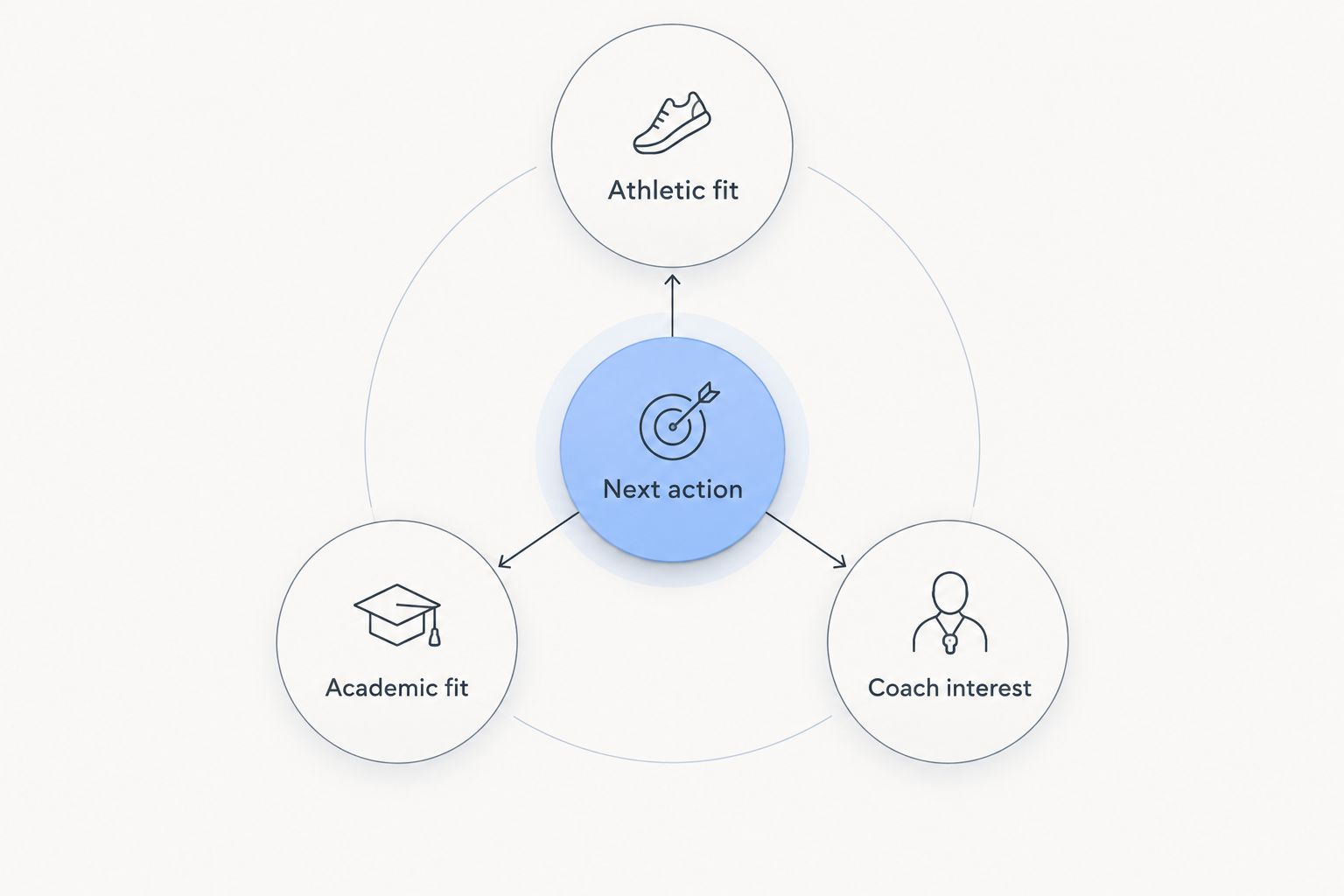
A platform earns its place when it helps you answer these questions more clearly. Keep them separate so an attractive athletic possibility does not obscure an academic mismatch, or a promising fit insight become mistaken for coach interest.
Pricing: compare the billing model before committing
For your 2026 comparison, confirm each platform's current billing structure directly. Establish whether payment is recurring, tied to a defined service, or organized another way before judging the commitment.
The billing tradeoff matters. A recurring arrangement requires you to understand renewal and cancellation terms; a defined-service arrangement requires you to understand exactly what work is included. These are evaluation criteria, not claims about either platform's current model.
Ask both providers the same questions:
- Which functions are included in the option you are considering?
- What triggers a renewal or another payment?
- What changes when you stop paying?
- Can you retain the information you entered?
- Are assistance and platform access separate commitments?
Do not decide based on a headline offer alone. Compare the commitment required to complete your actual recruiting task. A feature you will not use contributes nothing to that decision.
Final verdict: choose by the job you need done
Choose RecruitMyGame if you need profile-to-fit research
Best for: US high school student-athletes building a college recruiting process. Choose it when your priorities match its stated capabilities: building a profile, accessing Tosch.ai roster and coach-fit insights, and connecting with college coaches.
Its strongest case is the combination of those capabilities. Its boundary is that profiles and insights do not establish admissions eligibility, a roster place, or a coach's recruiting interest.
Choose Pathley if its demonstrated workflow fits you better
Best for: athletes with an existing shortlist and a clearly defined workflow requirement. Choose Pathley if you can complete that requirement in a hands-on evaluation and prefer the result to the alternative.
For example, bring your existing college list and demonstrate the exact research or contact task you need to complete. This is a conditional recommendation based on your evaluation, not a claim that Pathley has an unverified feature advantage.
For a 2026 decision, neither brand recognition nor a longer checklist should overrule that exercise. Choose the platform whose confirmed functions address your current obstacle.
| Dimension | Winner |
|---|---|
| Confirmed profile-building capability | Client platform; Pathley requires verification |
| Confirmed roster and coach-fit insights | Client platform through Tosch.ai |
| Confirmed college-coach connections | Client platform; Pathley requires verification |
| Your sport and target programs | Decide after checking both |
| Proof of coach interest | Neither; seek direct coach communication |
| Academic suitability | Neither; evaluate the college separately |
| Billing suitability | Decide after reviewing current terms |
| Existing-workflow preference | Pathley if your hands-on evaluation establishes the advantage |
FAQ
Is RecruitMyGame better than Pathley for college recruiting?
RecruitMyGame is a supported choice for athletes seeking profile building, Tosch.ai roster and coach-fit insights, and college-coach connections. Choose Pathley instead only when its demonstrated workflow better addresses your specific recruiting task.
Which platform should I choose if I already have a college list?
Choose the platform that helps you complete your next task with that list. Demonstrate how you would investigate a program or prepare a coach introduction before committing.
Does a roster-fit insight mean a college coach wants me?
No. A roster-fit insight is information to investigate, while recruiting interest must come from the coaching staff directly.
How do I compare the platforms' current costs?
Compare current billing terms directly with each provider. Check included functions, renewal conditions, cancellation terms, and what happens to your information when access ends.
Should I choose the platform that covers more sports?
Choose based on support for your own sport and target programs, not breadth alone. Confirm that the platform represents your athletic background accurately and supports the research you need.
Can either platform guarantee a college roster place?
Do not treat a profile, connection feature, or fit insight as a roster guarantee. Confirm any recruiting commitment directly with the college coaching staff.
What should I test before choosing a recruiting platform in 2026?
Test a complete athlete profile, a real target program, and the next action you would take. Use the same task on both platforms so your comparison reflects your needs.
One last thing
Before opening either platform, write this sentence: My next recruiting decision is _____. Fill it with an action such as selecting programs to investigate or preparing an introduction to a coach.
Then judge the platform against that sentence. A completed account is not the same as a completed recruiting task.