
Choose RecruitMyGame if you want a college recruiting platform built around athlete profiles, roster fit, and coach-fit insights; choose NCSA if your family wants recruiting guidance alongside the tools. In 2026, the useful distinction is independent decision-making versus a more guided recruiting process—not a promise that either service will get you recruited.
- RecruitMyGame vs NCSA comes down to roster-fit research versus a guided college recruiting process.
- Choose the fit-focused platform when you want to build your profile and investigate college coaches independently.
- Choose NCSA when recruiting guidance is the service your family needs; confirm the support included before committing.
- Neither a recruiting profile nor a paid service guarantees coach interest, admission, or an athletic scholarship.
Why this matters
A recruiting service should solve your next problem, not simply give you another account to maintain. A student-athlete who needs help identifying suitable programs has a different need from a family struggling to understand recruiting steps.
RecruitMyGame serves US high school student-athletes across 20+ sports, with profile building, Tosch.ai roster and coach-fit insights, and connections with college coaches. Those functions make program research a central part of its college recruiting platform.
Before choosing, name the task you cannot complete confidently today. That answer gives you a more useful comparison than a list of features you might never use.
At a glance
Use this 2026 comparison to separate the service you need from the support you should confirm directly. The table compares recruiting approaches; it does not assume that every NCSA membership includes the same assistance.
| Dimension | RecruitMyGame | NCSA |
|---|---|---|
| Best for | Athletes who want profile building and roster-fit research | Families seeking recruiting guidance alongside online tools |
| Standout feature | Roster and coach-fit insights from Tosch.ai | Recruiting education and coaching services |
| Independent research | Stronger match for a fit-focused, self-directed workflow | Consider when research needs additional guidance |
| Personal guidance | Do not confuse platform insights with individual counseling | Better match when human recruiting guidance is the priority |
| Accountability | Athlete or family should define the follow-up routine | Consider coaching support when outside structure is needed |
| Athlete profiles | Profile building is part of the platform | Recruiting profiles are part of the service |
| Recruiting outcomes | A tool for research and connection, not a guaranteed result | Support does not guarantee admission, roster placement, or aid |
| Pricing model | Evaluate the terms for platform access | Evaluate the membership terms and included services |
Roster-fit research favors the fit-focused platform
RecruitMyGame is best for high school athletes who want roster-fit and coach-fit research in their college recruiting workflow. Its stated offering combines athlete profiles with insights from Tosch.ai and connections to college coaches across 20+ sports.
That combination addresses a practical question: which programs deserve your attention? Building a profile is useful, but you also need a reason to contact a particular coaching staff.
Treat fit insights as a starting point for investigation. Check a program's current roster, academic offerings, and recruiting information before deciding it belongs on your list. An apparent athletic match is not confirmation that a coach needs your position or recruiting class.
The limitation is equally clear: information still requires judgment. You must evaluate the recommendation, prepare your materials, and decide what to ask the coach.
For a closer look at that decision, use the guide to roster-fit and coach-fit tools for college recruits. The important distinction is between finding a possible match and confirming one through direct research and conversation.
Independent athletes benefit more from a research-first workflow
A self-directed athlete needs tools that support decisions without turning every decision into a request for advice. Profile building and fit research align with that approach.
You are a good match for this workflow if you already know how to assemble your athletic information, compare schools, and write a clear introduction. The platform's role is to support that work, not replace your ownership of it.
The advantage is control; the drawback is responsibility. You decide which programs to investigate and which conversations to pursue, but you also have to notice when your approach is not working.
Do not choose a research-first platform because you assume that access alone creates momentum. If you repeatedly postpone outreach or cannot explain why a school is on your list, more information does not resolve the underlying problem.
For your 2026 recruiting plan, distinguish between needing better research and needing someone to help you act on it. Those are separate buying decisions.
NCSA is the better fit when you want recruiting guidance
NCSA is the more relevant option when your family wants recruiting education and coaching support, rather than primarily a research platform. Its recruiting services include guidance as well as online profiles and tools.
That matters when your questions concern the process itself: how to organize your search, what to prepare, and how to approach communication with college programs. A family unfamiliar with recruiting can place more value on explanation than on another research feature.
Confirm the support attached to the membership you are considering. Ask who provides it, how you access it, and what the service actually covers; do not assume that a general description applies to every membership.
NCSA wins this scenario when human guidance is the reason you are buying. The drawback is that guidance still requires your participation, and support that you do not use does not solve your recruiting problem.
NCSA fits families seeking outside structure
Accountability is different from access to information. You can understand the next step and still fail to complete it.
If that describes your situation, evaluate NCSA's coaching services for the structure you need. Ask how support translates into concrete next actions, rather than treating the existence of coaching as proof of a particular follow-up schedule.
Useful questions include whether the service helps you prioritize tasks, prepare for conversations, or review your approach. Get clear answers about the membership under consideration before treating any of those activities as included.
The tradeoff is involvement. Outside guidance adds value only when the athlete participates, supplies accurate information, and completes the agreed work.
A student-athlete who already manages those tasks independently has less reason to make accountability the deciding factor. For that athlete, fit research is the more relevant comparison dimension.
Both provide profiles; accuracy matters more than possession
Both options give student-athletes a recruiting-profile presence. That makes profile access a baseline consideration, not a sufficient reason to declare a winner.
Your profile needs to help a coach understand who you are. Use accurate athletic information, appropriate academic details, current contact information, and relevant video or results for your sport.
The limitation applies to both services: a profile is not evidence of recruiting interest. Nor does a completed profile mean that every coach you want to reach has reviewed it.
Call this dimension a tie unless you identify a specific profile function you need. Ask how you will update information and share the profile, then evaluate the actual workflow rather than the feature label.
For 2026, review your profile whenever your recruiting information changes. An attractive presentation cannot compensate for details that are no longer correct.
Neither service wins on guaranteed outcomes
Neither service can substitute for a college's admissions process, a coaching staff's recruiting decisions, or applicable eligibility requirements. A platform connection and a recruiting conversation are not the same as an offer.
This is an honest tie. The useful measure is whether the service helps you make better decisions and take relevant actions—not whether the word recruiting appears in its description.
Keep these distinctions explicit:
- Profile completion: your information is organized.
- Program research: you have investigated a possible match.
- Coach communication: you have exchanged information with a program.
- Confirmed interest: the coaching staff has communicated interest directly.
Do not collapse those stages into a single success claim. Ask what a coach actually said and what action follows from it.
Pricing: compare access with support, not labels
For both services, examine the current agreement before deciding. Separate what you receive through platform access from any guidance or other services included in the arrangement.
For the fit-focused platform, ask which profile, roster-fit, coach-fit, and connection functions the agreement covers. For NCSA, ask which tools and recruiting-support services belong to the specific membership you are considering.
The practical tradeoff is independent use versus service involvement. Platform access is useful when you can turn information into action; a guidance-oriented arrangement is useful when the included support addresses a task you cannot confidently handle yourself.
Compare billing frequency, contract length, renewal terms, cancellation terms, and the scope of support. Do not infer any of those conditions from a plan name or sales conversation.
Your 2026 comparison should use written terms for both options. Select the arrangement that matches your actual recruiting work, not an assumed level of assistance.
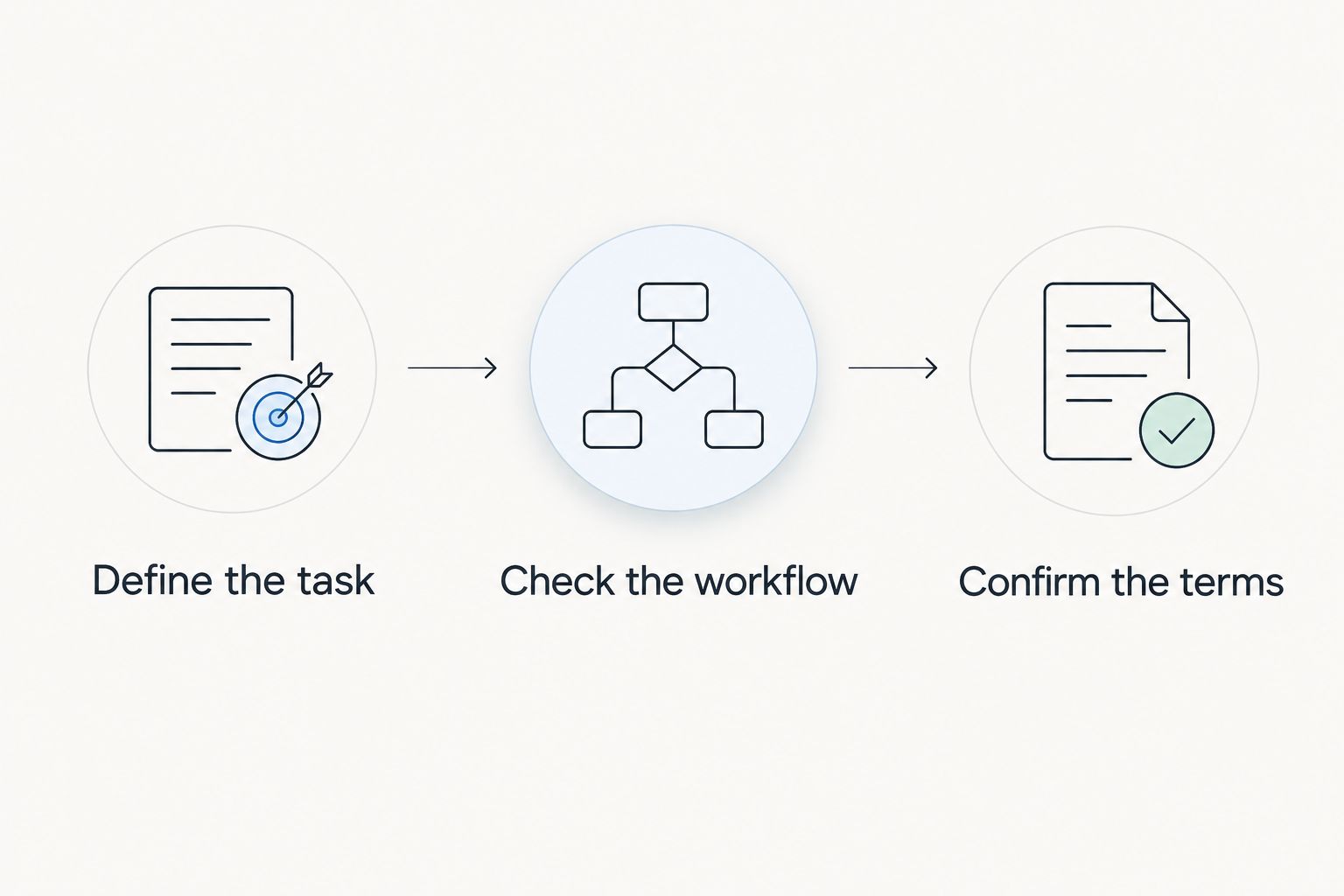
Make the decision in 3 steps
A short decision process keeps the comparison tied to your athlete's needs. Complete these 3 steps before committing to either approach.
Define the task
Write down the next recruiting task you need to finish. Use a concrete description such as researching suitable programs, assembling a profile, or understanding how to approach coaches.
Avoid goals such as getting recruited. That is an outcome involving other people's decisions, not a task a service can complete on your behalf.
Check the workflow
Ask each provider to explain how its service supports that task. Follow the path from your starting information to the action you would take next.
Ask 2 questions: what work does the service support, and what work remains yours? If the distinction is unclear, you cannot yet judge whether the offering fits.
Confirm the terms
Match the demonstrated workflow to the written agreement. Confirm the functions, support, and obligations attached to the option you are considering.
Then identify 1 next action you will take after joining. If you cannot name that action, return to the task definition before making the purchase decision.
Final verdict: choose around the work you need done
Choose RecruitMyGame if you are a self-directed researcher
The fit-focused college recruiting platform is the better match when you want athlete profiles, Tosch.ai roster and coach-fit insights, and connections with college coaches. You should be ready to evaluate programs and manage your own next steps.
This profile describes an athlete who wants help finding and investigating potential matches—not a substitute for personal follow-through.
Choose NCSA if you are a family seeking recruiting guidance
NCSA is the better match when recruiting education and coaching support are central to your decision. Confirm that the specific membership includes the assistance you need.
This profile describes a family that wants help understanding and organizing the process. The athlete still needs to participate actively.
| Dimension | Winner |
|---|---|
| Self-directed, fit-focused research | The fit-focused platform |
| Roster and coach-fit emphasis | The fit-focused platform |
| Human recruiting guidance | NCSA |
| Outside structure through coaching | NCSA, when the selected service provides it |
| Having an athlete profile | Tie |
| Guaranteed recruiting outcomes | Neither |
| Contract suitability | The option whose written terms match your needs |
FAQ
Is RecruitMyGame better than NCSA for college recruiting?
RecruitMyGame is the better match for self-directed athletes seeking profile building and roster and coach-fit insights. NCSA is the better match when recruiting guidance is the main reason for choosing a service.
Which option is better if my family is new to recruiting?
NCSA is the more relevant option when your family wants recruiting education and coaching support. Confirm exactly what assistance the membership under consideration includes.
Should I choose a recruiting service just to create a profile?
No—profile creation alone is not enough to distinguish these options. Compare how you will research programs, communicate with coaches, and complete your next recruiting task.
Does a roster-fit insight mean a coach wants to recruit me?
No—a roster-fit insight is a research starting point, not confirmation of coach interest. Check the program's current information and communicate directly with its coaching staff.
Can either recruiting service guarantee an athletic scholarship?
No—neither service can guarantee an athletic scholarship. Recruiting support does not replace institutional decisions or applicable eligibility requirements.
What should I check before choosing a recruiting membership in 2026?
Check the included functions, scope of support, billing frequency, contract length, renewal terms, and cancellation terms. Match those written terms to the recruiting task you need help completing.
One last thing
Before joining either service, choose a college already on your list and write down why it belongs there. Separate evidence from assumptions.
If your explanation is weak because you lack program information, prioritize research. If the information is clear but you do not know what to do next, prioritize guidance. That exercise makes your 2026 decision more concrete than another feature checklist.